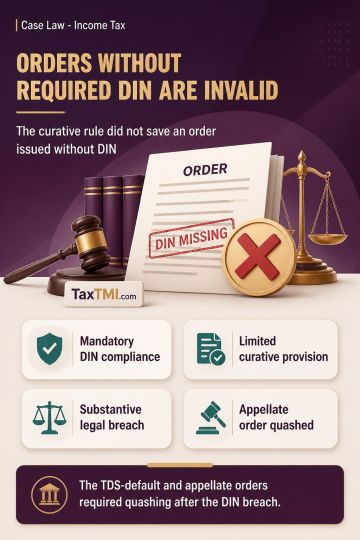
Document Identification Number compliance renders TDS-default orders invalid where mandatory DIN requirements are breached and curative provision does...
The CESTAT held that the importer was entitled to exemption under Notification No. 12/2012-CUS entry Sr. No. 108 description (A) for their drugs and bulk drugs, which did not involve conditions prescribed under description (B). Since the duty demand itself was unsustainable against the company, the personal penalty imposed on their employee (the appellant) u/r 26 of Central Excise Rules, 2012 for aiding or abetting duty evasion was set aside. The Tribunal observed no suppression of facts or mala fide intent by the company or the appellant in availing the notification. Relying on a Gujarat High Court decision, the personal penalty was held unsustainable for an interpretational issue. Consequently, the appeal was allowed.
The CESTAT held that the importer was entitled to exemption under Notification No. 12/2012-CUS entry Sr. No. 108 description (A) for their drugs and bulk drugs, which did not involve conditions prescribed under description (B). Since the duty demand itself was unsustainable against the company, the personal penalty imposed on their employee (the appellant) u/r 26 of Central Excise Rules, 2012 for aiding or abetting duty evasion was set aside. The Tribunal observed no suppression of facts or mala fide intent by the company or the appellant in availing the notification. Relying on a Gujarat High Court decision, the personal penalty was held unsustainable for an interpretational issue. Consequently, the appeal was allowed.
Note: It is a system-generated summary and is for quick reference only.
 TaxTMI
  TaxTMI
 of 4918