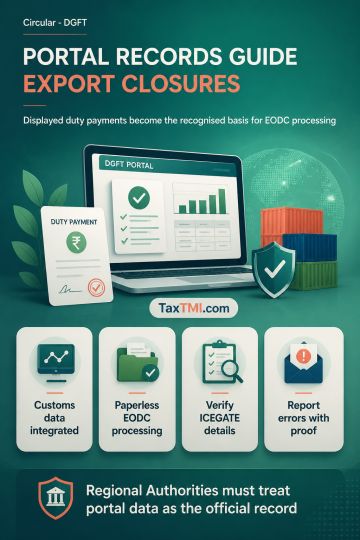
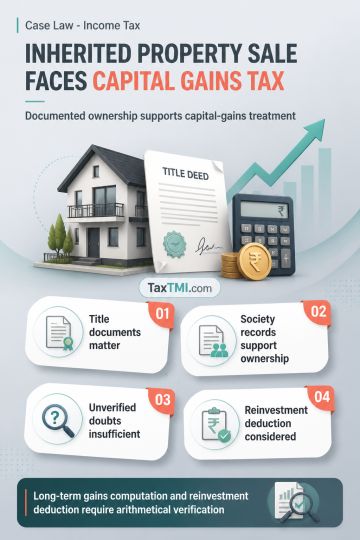
Inherited property sale proceeds require capital-gains treatment where ownership is supported by evidence, not suspicion or unverified signature doubt...
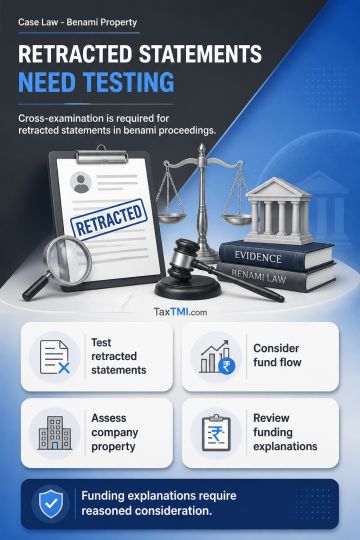
Cross-examination of retracted statements is essential where foundational evidence supports a benami allegation and documented funding explanations re...
Capital-goods exemption covers plant-modernisation accessories, while the import restriction applies only to earlier capital-goods components and spar...
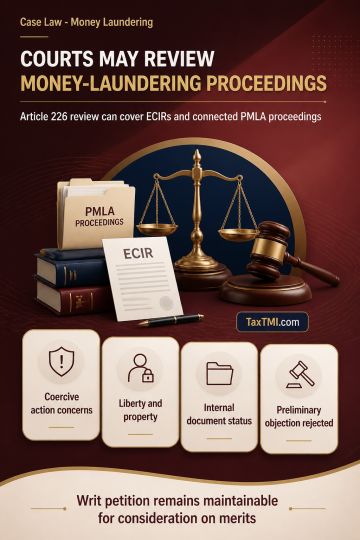
Constitutional judicial review permits challenges to ECIRs and connected money-laundering proceedings where coercive action affects fundamental intere...
The High Court dismissed the writ petition. The petitioner, being a registered person not liable for registration before the appointed day of 01.07.2017, sought entitlement to transitional credit of excise duty through Credit Transfer Document by filing TRAN-3 without submitting TRAN-1 declaration within the stipulated time u/r 117 of the Central Goods and Services Tax Rules, 2017. The Court held that the requirement of submitting TRAN-1 declaration is not merely procedural but substantive and mandatory u/s 140(3) of the CGST Act, 2017. The time limit prescribed for making the declaration is a statutory mandate, and the Rule Making Authority had to prescribe it consistently with the eligibility conditions in the law. Submission of TRAN-1 is not a mere formality but enables smooth availment of input tax credit by binding the claimant to solemnly declare eligibility. The Court rejected the argument that Rule 117 is merely directory, stating that such a provision in a fiscal statute providing time limit to avail credit is not only substantive but also mandatory.
The High Court dismissed the writ petition. The petitioner, being a registered person not liable for registration before the appointed day of 01.07.2017, sought entitlement to transitional credit of excise duty through Credit Transfer Document by filing TRAN-3 without submitting TRAN-1 declaration within the stipulated time u/r 117 of the Central Goods and Services Tax Rules, 2017. The Court held that the requirement of submitting TRAN-1 declaration is not merely procedural but substantive and mandatory u/s 140(3) of the CGST Act, 2017. The time limit prescribed for making the declaration is a statutory mandate, and the Rule Making Authority had to prescribe it consistently with the eligibility conditions in the law. Submission of TRAN-1 is not a mere formality but enables smooth availment of input tax credit by binding the claimant to solemnly declare eligibility. The Court rejected the argument that Rule 117 is merely directory, stating that such a provision in a fiscal statute providing time limit to avail credit is not only substantive but also mandatory.
Note: It is a system-generated summary and is for quick reference only.
 TaxTMI
 of 4784








 Join Channel


 TaxTMI