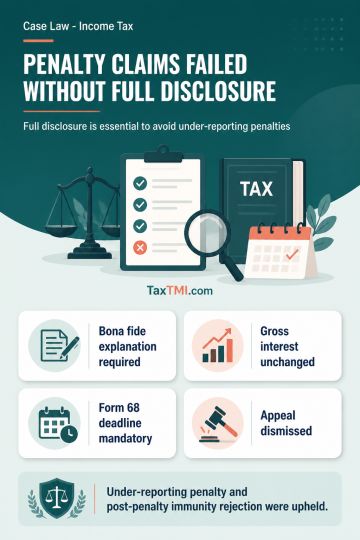
Bona fide disclosure requirements govern under-reporting penalties, and post-penalty immunity applications cannot secure available statutory protectio...
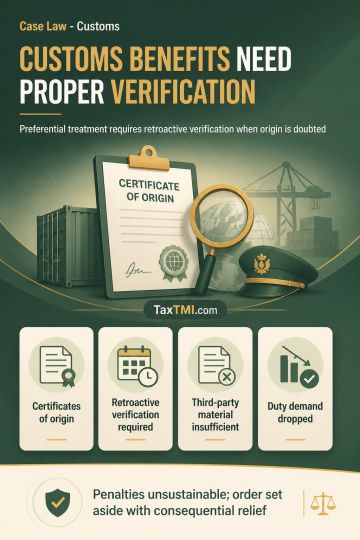
Certificate-of-origin verification procedure governs preferential customs benefits; denial without retroactive verification was set aside with consequ...
Disciplinary Committee jurisdiction and mandatory investigation requirements invalidated cancellation of an insolvency professional's registration and...
Retention of seized property survives where recorded reasons support proceeds of crime, while stayed investigation periods are excluded from limitatio...
The High Court dismissed the writ petition. The petitioner, being a registered person not liable for registration before the appointed day of 01.07.2017, sought entitlement to transitional credit of excise duty through Credit Transfer Document by filing TRAN-3 without submitting TRAN-1 declaration within the stipulated time u/r 117 of the Central Goods and Services Tax Rules, 2017. The Court held that the requirement of submitting TRAN-1 declaration is not merely procedural but substantive and mandatory u/s 140(3) of the CGST Act, 2017. The time limit prescribed for making the declaration is a statutory mandate, and the Rule Making Authority had to prescribe it consistently with the eligibility conditions in the law. Submission of TRAN-1 is not a mere formality but enables smooth availment of input tax credit by binding the claimant to solemnly declare eligibility. The Court rejected the argument that Rule 117 is merely directory, stating that such a provision in a fiscal statute providing time limit to avail credit is not only substantive but also mandatory.
The High Court dismissed the writ petition. The petitioner, being a registered person not liable for registration before the appointed day of 01.07.2017, sought entitlement to transitional credit of excise duty through Credit Transfer Document by filing TRAN-3 without submitting TRAN-1 declaration within the stipulated time u/r 117 of the Central Goods and Services Tax Rules, 2017. The Court held that the requirement of submitting TRAN-1 declaration is not merely procedural but substantive and mandatory u/s 140(3) of the CGST Act, 2017. The time limit prescribed for making the declaration is a statutory mandate, and the Rule Making Authority had to prescribe it consistently with the eligibility conditions in the law. Submission of TRAN-1 is not a mere formality but enables smooth availment of input tax credit by binding the claimant to solemnly declare eligibility. The Court rejected the argument that Rule 117 is merely directory, stating that such a provision in a fiscal statute providing time limit to avail credit is not only substantive but also mandatory.
Note: It is a system-generated summary and is for quick reference only.
 TaxTMI
 of 4798









 Join Channel


 TaxTMI
