Administrative fraud classification suspension does not halt independent criminal investigation or warrant-based searches into alleged economic offenc...
Arrest safeguards and transit remand requirements invalidated detention following inter-State transfer without communicated grounds or magistrate auth...
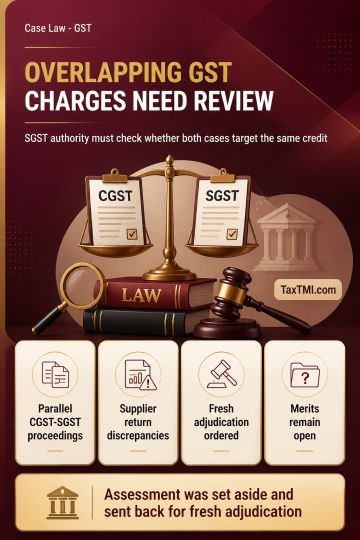
Arrest safeguards require disclosed grounds, relative intimation and transit remand, while duplicate prosecution under the CGST framework is unsustain...
Page of 4790
Press 'Enter' after typing page number.
521 to 540 of 95791 Results
❮
❯
❯❯
0 / 200
Expand Note
Add to Folder
No Folders have been created
+
Are you sure you want to delete "My most important" ?
The High Court dismissed the writ petition. The petitioner, being a registered person not liable for registration before the appointed day of 01.07.2017, sought entitlement to transitional credit of excise duty through Credit Transfer Document by filing TRAN-3 without submitting TRAN-1 declaration within the stipulated time u/r 117 of the Central Goods and Services Tax Rules, 2017. The Court held that the requirement of submitting TRAN-1 declaration is not merely procedural but substantive and mandatory u/s 140(3) of the CGST Act, 2017. The time limit prescribed for making the declaration is a statutory mandate, and the Rule Making Authority had to prescribe it consistently with the eligibility conditions in the law. Submission of TRAN-1 is not a mere formality but enables smooth availment of input tax credit by binding the claimant to solemnly declare eligibility. The Court rejected the argument that Rule 117 is merely directory, stating that such a provision in a fiscal statute providing time limit to avail credit is not only substantive but also mandatory.
The High Court dismissed the writ petition. The petitioner, being a registered person not liable for registration before the appointed day of 01.07.2017, sought entitlement to transitional credit of excise duty through Credit Transfer Document by filing TRAN-3 without submitting TRAN-1 declaration within the stipulated time u/r 117 of the Central Goods and Services Tax Rules, 2017. The Court held that the requirement of submitting TRAN-1 declaration is not merely procedural but substantive and mandatory u/s 140(3) of the CGST Act, 2017. The time limit prescribed for making the declaration is a statutory mandate, and the Rule Making Authority had to prescribe it consistently with the eligibility conditions in the law. Submission of TRAN-1 is not a mere formality but enables smooth availment of input tax credit by binding the claimant to solemnly declare eligibility. The Court rejected the argument that Rule 117 is merely directory, stating that such a provision in a fiscal statute providing time limit to avail credit is not only substantive but also mandatory.
Note: It is a system-generated summary and is for quick reference only.
 TaxTMI
 of 4790







 Join Channel


 TaxTMI

