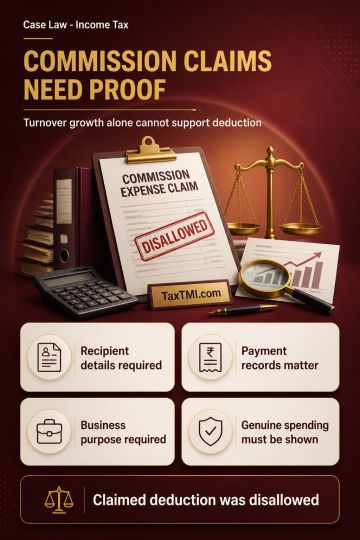
Business expenditure deduction requires proof of genuine commission payments and commercial allowability; turnover growth alone cannot validate the cl...
Article 8 treaty coverage excluded third-party airline support services, while documented demonetisation cash receipts remained accepted business inco...
Functional comparability under TNMM requires highway contract benchmarks to reflect operation, maintenance and transfer activities, requiring fresh be...
The High Court held that the phrase 'a residential house' in Section 54F of the Income Tax Act should be interpreted strictly to mean a single residential unit. The assessee was not entitled to claim exemption u/s 54F for investing in two separate flats located on different floors and at diagonally opposite ends, despite being in the same tower. The word 'a' denotes singular and not plural. The intent of the legislature was to grant exemption for investment in one residential house, not multiple residential units. However, the Court clarified that in certain cases where floors or houses are constructed to be used as one singular unit, they may qualify as 'a residential house' u/s 54F.
The High Court held that the phrase 'a residential house' in Section 54F of the Income Tax Act should be interpreted strictly to mean a single residential unit. The assessee was not entitled to claim exemption u/s 54F for investing in two separate flats located on different floors and at diagonally opposite ends, despite being in the same tower. The word 'a' denotes singular and not plural. The intent of the legislature was to grant exemption for investment in one residential house, not multiple residential units. However, the Court clarified that in certain cases where floors or houses are constructed to be used as one singular unit, they may qualify as 'a residential house' u/s 54F.
Note: It is a system-generated summary and is for quick reference only.
 TaxTMI
 of 4788











 Join Channel


 TaxTMI
