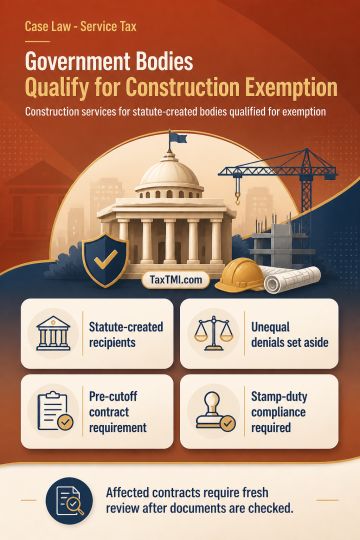
Governmental authority status supports construction-service exemption, while pre-cutoff contract and stamp-duty compliance requires verification on re...
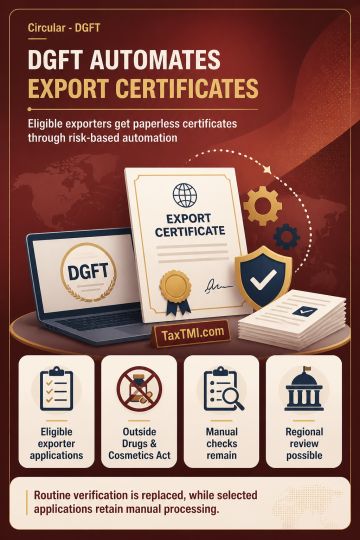
Automated Free Sale and Commerce Certificates enable paperless processing while retaining risk-based manual verification for selected exporter applica...
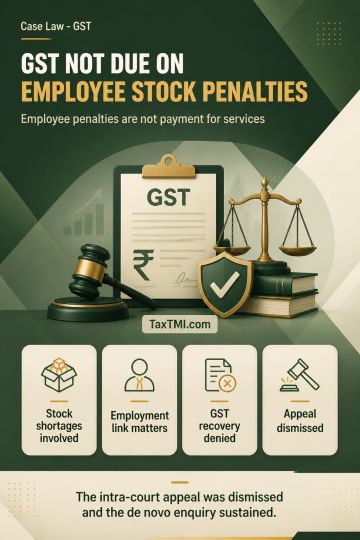
Employee stock-shortage penalties do not constitute consideration for services, preventing GST collection under Schedule II in employment relationship...
The petitioner issued two post-dated cheques bearing No. 622623 for Rs. 93,00,000/- and No. 622624 for Rs. 1,54,00,000/- to the respondent as per a Deed of Undertaking. The Deed stipulated that the petitioner would clear GST of Rs. 9,63,00,000/- for a firm, out of which 10% (Rs. 33,00,000/-) would be paid to the respondent. If the GST rate was 2%, the amount payable would be Rs. 1,54,00,000/-. The cheques were issued subject to fulfillment of certain conditions. The High Court held that such a stipulation regarding issuance of cheques could be valid. It found no ground to quash the complaint u/s 138 of the Negotiable Instruments Act or the cognizance taken by the Judicial Magistrate. The issues raised appeared to be matters for trial. The High Court rejected the petition invoking inherent powers for quashing, holding that no case for quashing was made out.
The petitioner issued two post-dated cheques bearing No. 622623 for Rs. 93,00,000/- and No. 622624 for Rs. 1,54,00,000/- to the respondent as per a Deed of Undertaking. The Deed stipulated that the petitioner would clear GST of Rs. 9,63,00,000/- for a firm, out of which 10% (Rs. 33,00,000/-) would be paid to the respondent. If the GST rate was 2%, the amount payable would be Rs. 1,54,00,000/-. The cheques were issued subject to fulfillment of certain conditions. The High Court held that such a stipulation regarding issuance of cheques could be valid. It found no ground to quash the complaint u/s 138 of the Negotiable Instruments Act or the cognizance taken by the Judicial Magistrate. The issues raised appeared to be matters for trial. The High Court rejected the petition invoking inherent powers for quashing, holding that no case for quashing was made out.
Note: It is a system-generated summary and is for quick reference only.
 TaxTMI
  TaxTMI
 of 4828



 Join Channel


