Online bond platforms may offer overseas-regulated products and tax-specific bonds subject to disclosures, compliance safeguards and revised complianc...
Corporate guarantee valuation permits actual ascertainable commission while barring retroactive application and extended-period penalties for bona fid...
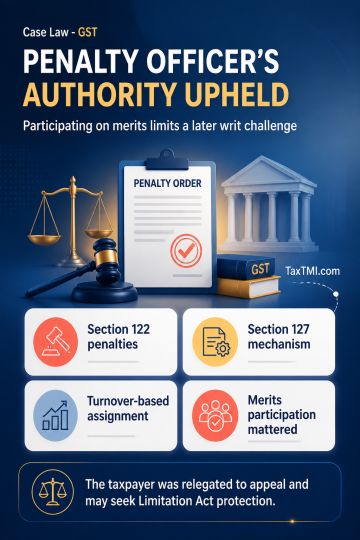
Proper-officer jurisdiction under UPGST penalty provisions upheld; participation on merits prevents bypassing the statutory appellate remedy through w...
Transitioned CENVAT credit may validly satisfy mandatory pre-deposit requirements for legacy service tax appeals through Electronic Credit Ledger debi...
Building-plan sanction charges require statutory authority; unauthorised fees and GST were quashed, while labour cess must follow prescribed collectio...
Pure-agent exclusion fails where hotel booking facilitators receive third-party services themselves, making entire customer consideration taxable as r...
The High Court's decision centers around the interpretation of Section 83 of the CGST/SGST Acts, which deals with provisional attachment orders. The key points are: Section 83(2) clearly states that a provisional attachment order will cease to have effect after one year from its issuance. Unlike the Income Tax Act, the GST Acts do not provide for extending this one-year period. The court held that accepting the Revenue's contention of issuing repeated attachment orders would violate the statute's language and legislative intent. The court relied on Supreme Court precedents like Radha Krishnan Industries and Vodafone International Holdings, which emphasize interpreting statutes based on their plain meaning and not supplying words or giving different meanings, even if it serves a larger public interest. Consequently, the court quashed the impugned attachment orders, declaring that Section 83 does not authorize fresh attachment orders after the one-year period specified in Section 83(2).
The High Court's decision centers around the interpretation of Section 83 of the CGST/SGST Acts, which deals with provisional attachment orders. The key points are: Section 83(2) clearly states that a provisional attachment order will cease to have effect after one year from its issuance. Unlike the Income Tax Act, the GST Acts do not provide for extending this one-year period. The court held that accepting the Revenue's contention of issuing repeated attachment orders would violate the statute's language and legislative intent. The court relied on Supreme Court precedents like Radha Krishnan Industries and Vodafone International Holdings, which emphasize interpreting statutes based on their plain meaning and not supplying words or giving different meanings, even if it serves a larger public interest. Consequently, the court quashed the impugned attachment orders, declaring that Section 83 does not authorize fresh attachment orders after the one-year period specified in Section 83(2).
Note: It is a system-generated summary and is for quick reference only.
 TaxTMI
 of 4800















 Join Channel


 TaxTMI