Retention of seized property survives where recorded reasons support proceeds of crime, while stayed investigation periods are excluded from limitatio...
Specified income of Baddi Barotiwala Nalagarh Development Authority receives conditional tax exemption, retrospectively covering its designated assess...
Specified development authority income receives retrospective tax exemption, subject to non-commercial activity, unchanged income sources, and return-...
Unified Brand India framework introduces voluntary Trust Mark certification and funding support for export branding, packaging and global promotional ...
Origin Declaration authentication governs preferential tariff claims under India-UK CETA, requiring a validated reference number before import clearan...
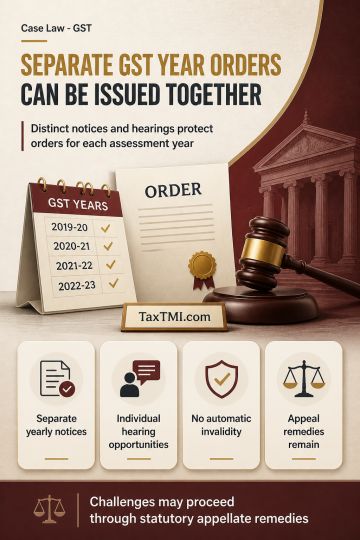
Separate assessment orders for different years remain valid when distinct notices and hearing opportunities prevent prejudice from combined proceeding...
The High Court's decision centers around the interpretation of Section 83 of the CGST/SGST Acts, which deals with provisional attachment orders. The key points are: Section 83(2) clearly states that a provisional attachment order will cease to have effect after one year from its issuance. Unlike the Income Tax Act, the GST Acts do not provide for extending this one-year period. The court held that accepting the Revenue's contention of issuing repeated attachment orders would violate the statute's language and legislative intent. The court relied on Supreme Court precedents like Radha Krishnan Industries and Vodafone International Holdings, which emphasize interpreting statutes based on their plain meaning and not supplying words or giving different meanings, even if it serves a larger public interest. Consequently, the court quashed the impugned attachment orders, declaring that Section 83 does not authorize fresh attachment orders after the one-year period specified in Section 83(2).
The High Court's decision centers around the interpretation of Section 83 of the CGST/SGST Acts, which deals with provisional attachment orders. The key points are: Section 83(2) clearly states that a provisional attachment order will cease to have effect after one year from its issuance. Unlike the Income Tax Act, the GST Acts do not provide for extending this one-year period. The court held that accepting the Revenue's contention of issuing repeated attachment orders would violate the statute's language and legislative intent. The court relied on Supreme Court precedents like Radha Krishnan Industries and Vodafone International Holdings, which emphasize interpreting statutes based on their plain meaning and not supplying words or giving different meanings, even if it serves a larger public interest. Consequently, the court quashed the impugned attachment orders, declaring that Section 83 does not authorize fresh attachment orders after the one-year period specified in Section 83(2).
Note: It is a system-generated summary and is for quick reference only.
 TaxTMI
  TaxTMI
 of 4807


















 Join Channel


