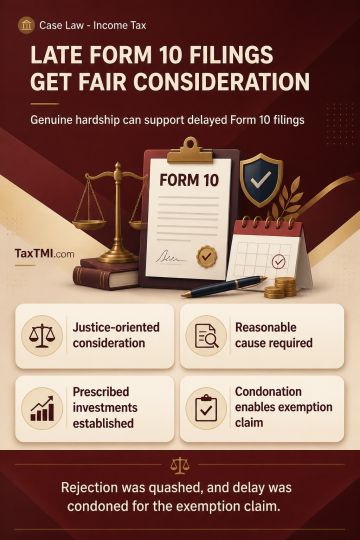
Specified regulatory authority income receives conditional tax exemption, subject to non-commercial activity, unchanged income character, and return f...
Tax exemption for regulatory authority income applies retrospectively, subject to non-commercial activity, unchanged income sources, and return-filing...
Input tax credit conditions remain constitutionally valid, with eligible recipient claims considered under GST circulars and retrospective filing dead...
Bogus donation receipts justified commission income assessment and defeated political-party tax exemption for inaccurate accounts and reporting failur...
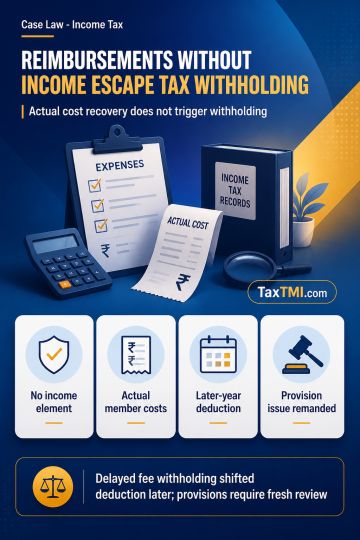
Pure reimbursement without income element escapes tax withholding, while delayed withholding and unsupported provisions face deferred or renewed scrut...
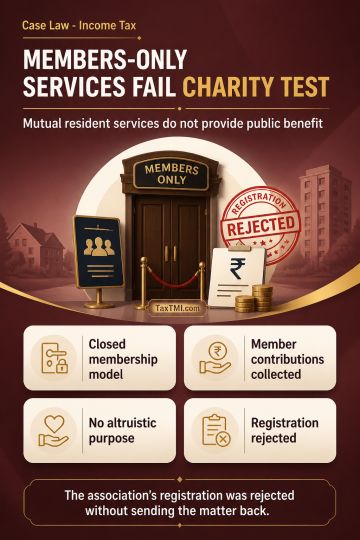
Public benefit requirement defeats charitable registration where residents' association services are reciprocal, member-only facilities governed by mu...
The High Court's decision centers around the interpretation of Section 83 of the CGST/SGST Acts, which deals with provisional attachment orders. The key points are: Section 83(2) clearly states that a provisional attachment order will cease to have effect after one year from its issuance. Unlike the Income Tax Act, the GST Acts do not provide for extending this one-year period. The court held that accepting the Revenue's contention of issuing repeated attachment orders would violate the statute's language and legislative intent. The court relied on Supreme Court precedents like Radha Krishnan Industries and Vodafone International Holdings, which emphasize interpreting statutes based on their plain meaning and not supplying words or giving different meanings, even if it serves a larger public interest. Consequently, the court quashed the impugned attachment orders, declaring that Section 83 does not authorize fresh attachment orders after the one-year period specified in Section 83(2).
The High Court's decision centers around the interpretation of Section 83 of the CGST/SGST Acts, which deals with provisional attachment orders. The key points are: Section 83(2) clearly states that a provisional attachment order will cease to have effect after one year from its issuance. Unlike the Income Tax Act, the GST Acts do not provide for extending this one-year period. The court held that accepting the Revenue's contention of issuing repeated attachment orders would violate the statute's language and legislative intent. The court relied on Supreme Court precedents like Radha Krishnan Industries and Vodafone International Holdings, which emphasize interpreting statutes based on their plain meaning and not supplying words or giving different meanings, even if it serves a larger public interest. Consequently, the court quashed the impugned attachment orders, declaring that Section 83 does not authorize fresh attachment orders after the one-year period specified in Section 83(2).
Note: It is a system-generated summary and is for quick reference only.
 TaxTMI
 of 4805
















 Join Channel


 TaxTMI