Transaction value cannot be rejected solely on non-statutory valuation guidelines without corroborative evidence supporting reassessment of final cust...
Cross-examination rights and corroborated evidence limit customs penalties for misdeclaration in genuine import transactions involving documented clea...
Tariff classification of vehicle gear components follows the specific gearing entry, displacing motor-vehicle parts classification and related liabili...
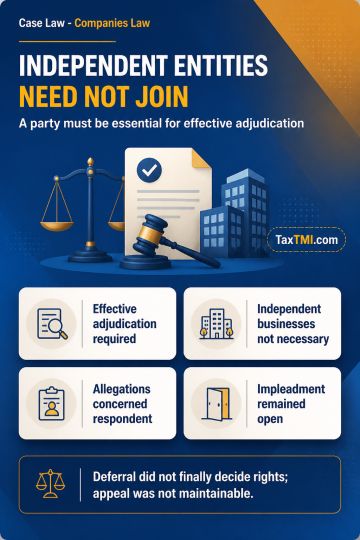
Necessary-party requirements limit impleadment of independent entities, while deferred consideration does not create an appealable adverse determinati...
Food supplement classification requires common parlance and authoritative tests, preventing treatment as proprietary Ayurvedic medicines without suppo...
The High Court's decision centers around the interpretation of Section 83 of the CGST/SGST Acts, which deals with provisional attachment orders. The key points are: Section 83(2) clearly states that a provisional attachment order will cease to have effect after one year from its issuance. Unlike the Income Tax Act, the GST Acts do not provide for extending this one-year period. The court held that accepting the Revenue's contention of issuing repeated attachment orders would violate the statute's language and legislative intent. The court relied on Supreme Court precedents like Radha Krishnan Industries and Vodafone International Holdings, which emphasize interpreting statutes based on their plain meaning and not supplying words or giving different meanings, even if it serves a larger public interest. Consequently, the court quashed the impugned attachment orders, declaring that Section 83 does not authorize fresh attachment orders after the one-year period specified in Section 83(2).
The High Court's decision centers around the interpretation of Section 83 of the CGST/SGST Acts, which deals with provisional attachment orders. The key points are: Section 83(2) clearly states that a provisional attachment order will cease to have effect after one year from its issuance. Unlike the Income Tax Act, the GST Acts do not provide for extending this one-year period. The court held that accepting the Revenue's contention of issuing repeated attachment orders would violate the statute's language and legislative intent. The court relied on Supreme Court precedents like Radha Krishnan Industries and Vodafone International Holdings, which emphasize interpreting statutes based on their plain meaning and not supplying words or giving different meanings, even if it serves a larger public interest. Consequently, the court quashed the impugned attachment orders, declaring that Section 83 does not authorize fresh attachment orders after the one-year period specified in Section 83(2).
Note: It is a system-generated summary and is for quick reference only.
 TaxTMI
 of 4805




















 Join Channel


 TaxTMI
