Bogus donation receipts justified commission income assessment and defeated political-party tax exemption for inaccurate accounts and reporting failur...
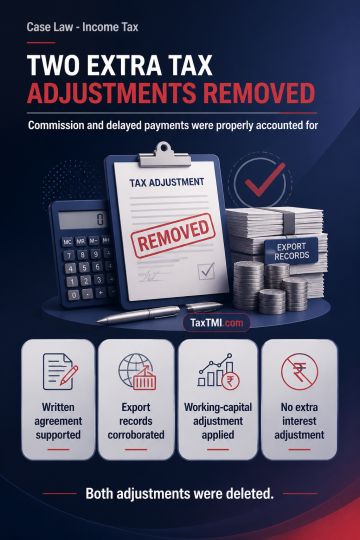
Pure reimbursement without income element escapes tax withholding, while delayed withholding and unsupported provisions face deferred or renewed scrut...
Public benefit requirement defeats charitable registration where residents' association services are reciprocal, member-only facilities governed by mu...
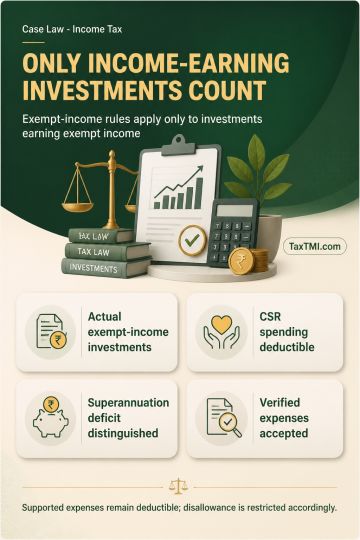
Exempt-income expenditure disallowance is confined to investments that actually generated exempt income, while supported business expenses remain dedu...
Objective characteristics and principal use govern mining-tyre classification, while fresh advance ruling applications may rely on additional technica...
Page of 4805
Press 'Enter' after typing page number.
801 to 820 of 96092 Results
❮
❯
❯❯
0 / 200
Expand Note
Add to Folder
No Folders have been created
+
Are you sure you want to delete "My most important" ?
Applicability: The waiver provisions u/s 128A apply to cases involving tax demands u/s 73 for financial years 2017-18, 2018-19, and 2019-20, and cases involving erroneous refunds. To avail the waiver, the full tax amount demanded must be paid by the notified date, excluding amounts no longer payable due to retrospective amendments to Section 16(5) and 16(6). Procedure: Applications for waiver must be filed in prescribed forms, and proper officers will examine eligibility. Notices may be issued, and applicants can file replies. Orders approving or rejecting waiver applications will be issued, with deemed approval if no order is passed within the time limit. Appeals against rejection orders are allowed. Payments: Amounts paid towards the demand before the notified date, including by tax officers recovering from other persons, are considered payments for eligibility. Interest/penalty amounts cannot be adjusted against tax dues. Partial payments do not qualify for waiver. ITC can be utilized for payment, except for reverse charge/e-commerce operator liabilities and erroneous refund demands. Clarifications: The circular provides clarifications on various issues, including applicability to IGST/Cess demands, transitional credit demands, penalties under other provisions, import IGST.
Applicability: The waiver provisions u/s 128A apply to cases involving tax demands u/s 73 for financial years 2017-18, 2018-19, and 2019-20, and cases involving erroneous refunds. To avail the waiver, the full tax amount demanded must be paid by the notified date, excluding amounts no longer payable due to retrospective amendments to Section 16(5) and 16(6). Procedure: Applications for waiver must be filed in prescribed forms, and proper officers will examine eligibility. Notices may be issued, and applicants can file replies. Orders approving or rejecting waiver applications will be issued, with deemed approval if no order is passed within the time limit. Appeals against rejection orders are allowed. Payments: Amounts paid towards the demand before the notified date, including by tax officers recovering from other persons, are considered payments for eligibility. Interest/penalty amounts cannot be adjusted against tax dues. Partial payments do not qualify for waiver. ITC can be utilized for payment, except for reverse charge/e-commerce operator liabilities and erroneous refund demands. Clarifications: The circular provides clarifications on various issues, including applicability to IGST/Cess demands, transitional credit demands, penalties under other provisions, import IGST.
Note: It is a system-generated summary and is for quick reference only.
 TaxTMI
 of 4805















 Join Channel


 TaxTMI