Exempt-income expenditure disallowance is confined to investments that actually generated exempt income, while supported business expenses remain dedu...
Objective characteristics and principal use govern mining-tyre classification, while fresh advance ruling applications may rely on additional technica...
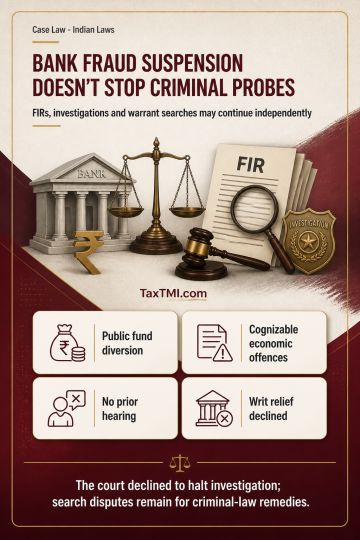
Administrative fraud classification suspension does not halt independent criminal investigation or warrant-based searches into alleged economic offenc...
The High Court addressed the validity of a show cause notice (SCN) and final order issued against a non-existent entity, the rectification of procedural defects, and the applicability of Sections 160 and 87 of the CGST Act, 2017, concerning amalgamated companies. Section 87 seeks to preserve and identify transactions between companies that ultimately amalgamate, fixing liabilities under the CGST Act. However, it cannot enable issuing notices or orders against a non-existent entity, as the liabilities would transpose to the amalgamated entity. Consequently, the impugned SCN and order were quashed, and the petition was allowed.
The High Court addressed the validity of a show cause notice (SCN) and final order issued against a non-existent entity, the rectification of procedural defects, and the applicability of Sections 160 and 87 of the CGST Act, 2017, concerning amalgamated companies. Section 87 seeks to preserve and identify transactions between companies that ultimately amalgamate, fixing liabilities under the CGST Act. However, it cannot enable issuing notices or orders against a non-existent entity, as the liabilities would transpose to the amalgamated entity. Consequently, the impugned SCN and order were quashed, and the petition was allowed.
Note: It is a system-generated summary and is for quick reference only.
 TaxTMI
 of 4805











 Join Channel


 TaxTMI