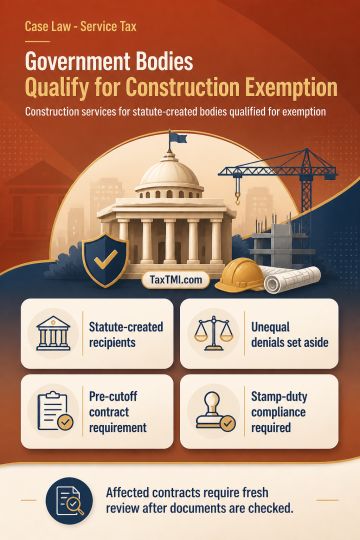
Governmental authority status supports construction-service exemption, while pre-cutoff contract and stamp-duty compliance requires verification on re...
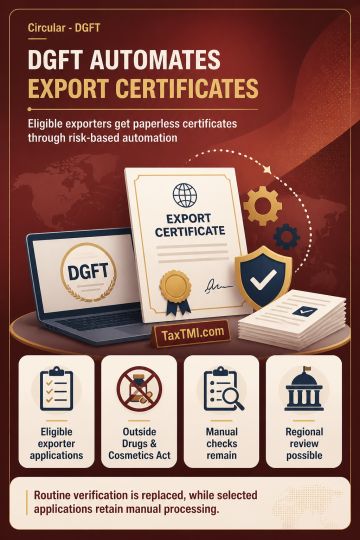
Automated Free Sale and Commerce Certificates enable paperless processing while retaining risk-based manual verification for selected exporter applica...
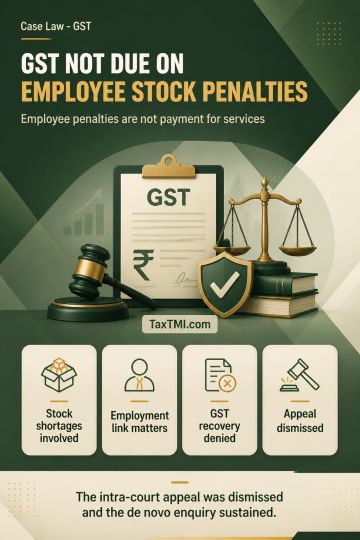
Employee stock-shortage penalties do not constitute consideration for services, preventing GST collection under Schedule II in employment relationship...
Section 179 of the Income Tax Act empowers tax authorities to recover outstanding dues from directors of private companies during the relevant previous year. The latter part casts a negative onus on directors to prove non-recovery was not due to gross neglect, misfeasance, or breach of duty. In this case, the company was incorporated as a public limited company, and the revenue authorities failed to dispute this status while initiating proceedings u/s 179. Consequently, the High Court held that Section 179 is inapplicable to public limited companies, and the writ petition was allowed.
Section 179 of the Income Tax Act empowers tax authorities to recover outstanding dues from directors of private companies during the relevant previous year. The latter part casts a negative onus on directors to prove non-recovery was not due to gross neglect, misfeasance, or breach of duty. In this case, the company was incorporated as a public limited company, and the revenue authorities failed to dispute this status while initiating proceedings u/s 179. Consequently, the High Court held that Section 179 is inapplicable to public limited companies, and the writ petition was allowed.
Note: It is a system-generated summary and is for quick reference only.
 TaxTMI
  TaxTMI
 of 4828




 Join Channel


