Customs Broker association membership becomes mandatory in the operating jurisdiction, with exclusive membership and limited compliance-time relaxatio...
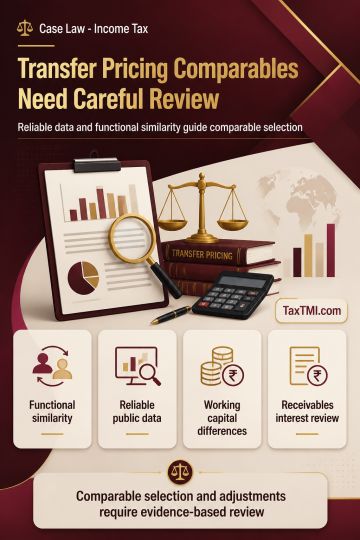
Transfer pricing comparability requires functional alignment, reliable financial data, and careful review of working capital and receivables adjustmen...
Transfer pricing rules require benchmarking corporate guarantees and associated-enterprise advances, while invalid domestic-transaction adjustments ca...
Page of 4788
Press 'Enter' after typing page number.
241 to 260 of 95749 Results
❮
❯
❯❯
0 / 200
Expand Note
Add to Folder
No Folders have been created
+
Are you sure you want to delete "My most important" ?
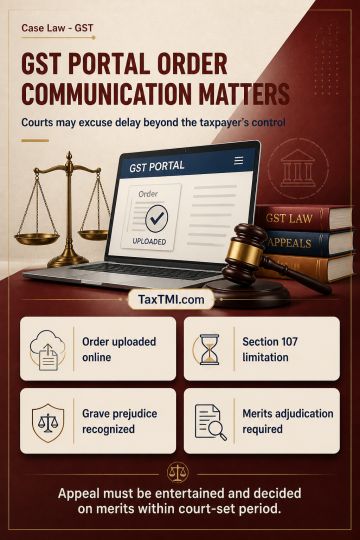
The petitioner filed appeals against orders under CGST/SGST Acts after a delay of four years. The court held that it cannot normally exercise jurisdiction under Article 226 to extend the time limit for filing appeals u/s 107 of the CGST/SGST Acts, as per the Supreme Court's rulings in Singh Enterprises and Ketan V. Parekh cases. Although Section 5 of the Limitation Act may not apply, the benefit of Section 14 can be extended in rare cases with extraordinary circumstances, which were not present in this case. Despite Article 226 not fixing a limitation period for writ petitions, inordinate delay in filing can lead to dismissal. The petitioner's contention of illness was viewed with suspicion. Consequently, the writ petition was dismissed due to the failure to approach the court within a reasonable time and the absence of extraordinary circumstances justifying condonation of delay.
The petitioner filed appeals against orders under CGST/SGST Acts after a delay of four years. The court held that it cannot normally exercise jurisdiction under Article 226 to extend the time limit for filing appeals u/s 107 of the CGST/SGST Acts, as per the Supreme Court's rulings in Singh Enterprises and Ketan V. Parekh cases. Although Section 5 of the Limitation Act may not apply, the benefit of Section 14 can be extended in rare cases with extraordinary circumstances, which were not present in this case. Despite Article 226 not fixing a limitation period for writ petitions, inordinate delay in filing can lead to dismissal. The petitioner's contention of illness was viewed with suspicion. Consequently, the writ petition was dismissed due to the failure to approach the court within a reasonable time and the absence of extraordinary circumstances justifying condonation of delay.
Note: It is a system-generated summary and is for quick reference only.
 TaxTMI
 of 4788










 Join Channel


 TaxTMI