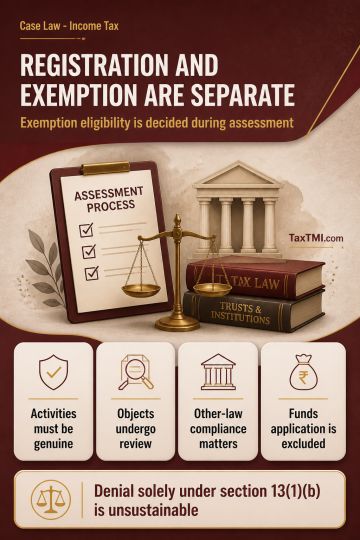
Defined public benefit can retain charitable character; registration renewal requires examining genuine activities and legal compliance, not surplus a...
Capital reduction is distinct from share buy-back, preventing buy-back tax; restructuring interest and related business deductions also survive scruti...
Transfer pricing and tax deductions upheld on established principles, while employee contributions and warranty provisions returned for fresh examinat...
Captive transfer pricing relies on industrial consumer tariffs, while genuine quotations can benchmark effluent treatment transfers under the Other Me...
Specific tariff classification for ophthalmic instruments and extended limitation principles determine the treatment of duty demands, confiscation, an...
Page of 4801
Press 'Enter' after typing page number.
1161 to 1180 of 96001 Results
❮
❯
❯❯
0 / 200
Expand Note
Add to Folder
No Folders have been created
+
Are you sure you want to delete "My most important" ?
The case revolves around the taxation of income earned by the assessee from licensing software to Indian customers under the India-USA Double Taxation Avoidance Agreement (DTAA). The key points are: The assessee provided the right to use computer software licenses through End User License Agreements (EULAs) or reseller agreements to Indian customers. It contended that such income was not taxable u/s 9(1)(vii) of the Income Tax Act or Article 12 (Royalty) of the India-USA DTAA. The ITAT held that the assessee's reliance on the Supreme Court decision in Engineering Analysis Centre of Excellence Pvt. Ltd. was well-founded. The transaction fell under the second category of software sale, granting non-exclusive restrictive licenses, which would not be covered under the definition of royalty as per the DTAA and hence not taxable in India. Regarding technical support services, the ITAT found that the receipts from DXC Technology India Private Limited, which had a separate clause for such services, constituted only 0.11% of the total receipts. The Assessing Officer erred in concluding that the entire receipts would fall under technical services. The ITAT held that for services to be considered 'Fees for Technical Services' under Article 12 of the India-US treaty.
The case revolves around the taxation of income earned by the assessee from licensing software to Indian customers under the India-USA Double Taxation Avoidance Agreement (DTAA). The key points are: The assessee provided the right to use computer software licenses through End User License Agreements (EULAs) or reseller agreements to Indian customers. It contended that such income was not taxable u/s 9(1)(vii) of the Income Tax Act or Article 12 (Royalty) of the India-USA DTAA. The ITAT held that the assessee's reliance on the Supreme Court decision in Engineering Analysis Centre of Excellence Pvt. Ltd. was well-founded. The transaction fell under the second category of software sale, granting non-exclusive restrictive licenses, which would not be covered under the definition of royalty as per the DTAA and hence not taxable in India. Regarding technical support services, the ITAT found that the receipts from DXC Technology India Private Limited, which had a separate clause for such services, constituted only 0.11% of the total receipts. The Assessing Officer erred in concluding that the entire receipts would fall under technical services. The ITAT held that for services to be considered 'Fees for Technical Services' under Article 12 of the India-US treaty.
Note: It is a system-generated summary and is for quick reference only.
 TaxTMI
 of 4801



















 Join Channel


 TaxTMI

