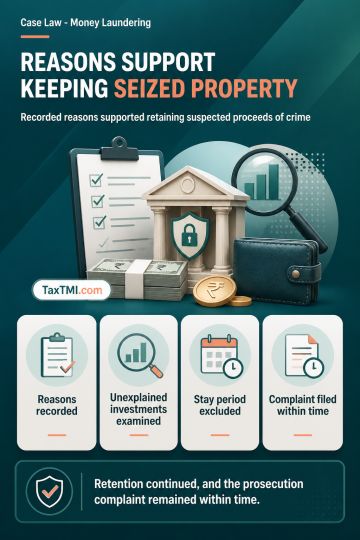
Retention of seized property survives where recorded reasons support proceeds of crime, while stayed investigation periods are excluded from limitatio...
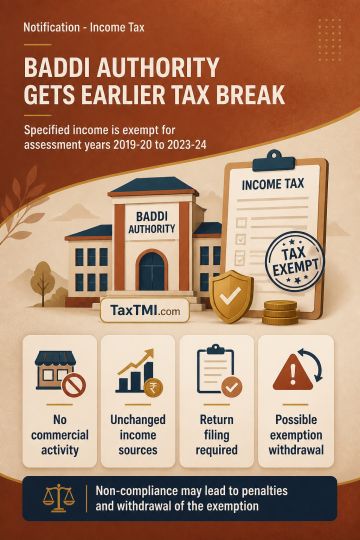
Specified income of Baddi Barotiwala Nalagarh Development Authority receives conditional tax exemption, retrospectively covering its designated assess...
Specified development authority income receives retrospective tax exemption, subject to non-commercial activity, unchanged income sources, and return-...
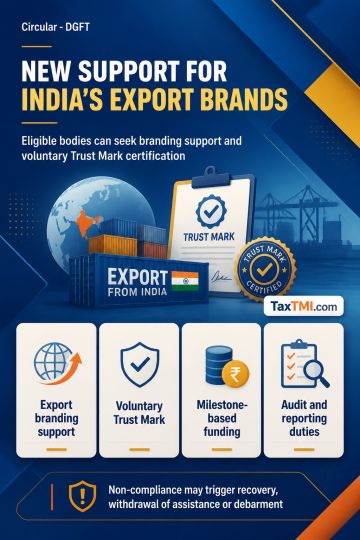
Unified Brand India framework introduces voluntary Trust Mark certification and funding support for export branding, packaging and global promotional ...
Origin Declaration authentication governs preferential tariff claims under India-UK CETA, requiring a validated reference number before import clearan...
Separate assessment orders for different years remain valid when distinct notices and hearing opportunities prevent prejudice from combined proceeding...
The case revolves around the taxation of income earned by the assessee from licensing software to Indian customers under the India-USA Double Taxation Avoidance Agreement (DTAA). The key points are: The assessee provided the right to use computer software licenses through End User License Agreements (EULAs) or reseller agreements to Indian customers. It contended that such income was not taxable u/s 9(1)(vii) of the Income Tax Act or Article 12 (Royalty) of the India-USA DTAA. The ITAT held that the assessee's reliance on the Supreme Court decision in Engineering Analysis Centre of Excellence Pvt. Ltd. was well-founded. The transaction fell under the second category of software sale, granting non-exclusive restrictive licenses, which would not be covered under the definition of royalty as per the DTAA and hence not taxable in India. Regarding technical support services, the ITAT found that the receipts from DXC Technology India Private Limited, which had a separate clause for such services, constituted only 0.11% of the total receipts. The Assessing Officer erred in concluding that the entire receipts would fall under technical services. The ITAT held that for services to be considered 'Fees for Technical Services' under Article 12 of the India-US treaty.
The case revolves around the taxation of income earned by the assessee from licensing software to Indian customers under the India-USA Double Taxation Avoidance Agreement (DTAA). The key points are: The assessee provided the right to use computer software licenses through End User License Agreements (EULAs) or reseller agreements to Indian customers. It contended that such income was not taxable u/s 9(1)(vii) of the Income Tax Act or Article 12 (Royalty) of the India-USA DTAA. The ITAT held that the assessee's reliance on the Supreme Court decision in Engineering Analysis Centre of Excellence Pvt. Ltd. was well-founded. The transaction fell under the second category of software sale, granting non-exclusive restrictive licenses, which would not be covered under the definition of royalty as per the DTAA and hence not taxable in India. Regarding technical support services, the ITAT found that the receipts from DXC Technology India Private Limited, which had a separate clause for such services, constituted only 0.11% of the total receipts. The Assessing Officer erred in concluding that the entire receipts would fall under technical services. The ITAT held that for services to be considered 'Fees for Technical Services' under Article 12 of the India-US treaty.
Note: It is a system-generated summary and is for quick reference only.
 TaxTMI
 of 4800











 Join Channel


 TaxTMI
