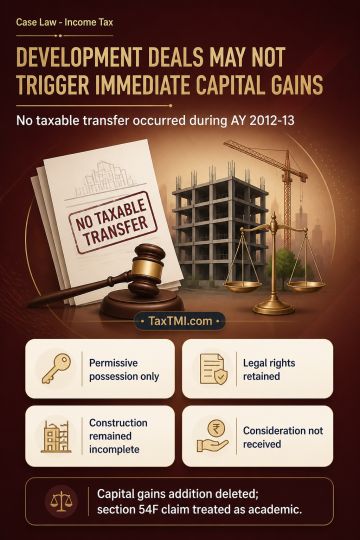
Development agreements require legal possession or effective enjoyment for capital gains transfer; permissive possession and deferred consideration de...
Prolonged sterilisation of development rights supports capital-gains treatment, while business-income disallowances cannot govern capital-gains comput...
Additional evidence in transfer pricing dispute leads to fresh examination, while tax deductions, TDS credit, fee and refund interest require verifica...
Category II AIF pass-through taxation preserves non-business income character; investment receipts cannot be reclassified without applying recognised ...
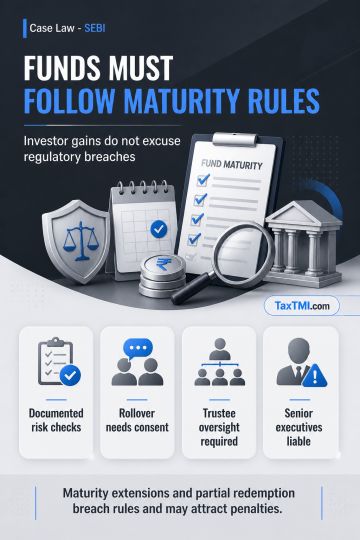
Mutual fund maturity rules require proper rollover, redemption, disclosure, and due diligence; investor gains cannot excuse regulatory breaches or pen...
Page of 4798
Press 'Enter' after typing page number.
1161 to 1180 of 95957 Results
❮
❯
❯❯
0 / 200
Expand Note
Add to Folder
No Folders have been created
+
Are you sure you want to delete "My most important" ?
When a service provider has already paid 100% service tax on manpower supply and security services, demanding the same service tax from the service recipient, who is liable to pay service tax on reverse charge basis, amounts to double taxation on the same service, which is not permissible. Even though the service recipient is liable to pay service tax on reverse charge basis, once the service provider has paid the service tax, the same cannot be recovered twice from the recipient. Since the service tax payment by the provider is correct, it is admissible as Cenvat credit to the recipient. Therefore, neither the service tax demand against the recipient nor the demand of Cenvat credit of the same amount is sustainable.
When a service provider has already paid 100% service tax on manpower supply and security services, demanding the same service tax from the service recipient, who is liable to pay service tax on reverse charge basis, amounts to double taxation on the same service, which is not permissible. Even though the service recipient is liable to pay service tax on reverse charge basis, once the service provider has paid the service tax, the same cannot be recovered twice from the recipient. Since the service tax payment by the provider is correct, it is admissible as Cenvat credit to the recipient. Therefore, neither the service tax demand against the recipient nor the demand of Cenvat credit of the same amount is sustainable.
Note: It is a system-generated summary and is for quick reference only.
 TaxTMI
 of 4798
















 Join Channel


 TaxTMI