Development agreements require legal possession or effective enjoyment for capital gains transfer; permissive possession and deferred consideration de...
Prolonged sterilisation of development rights supports capital-gains treatment, while business-income disallowances cannot govern capital-gains comput...
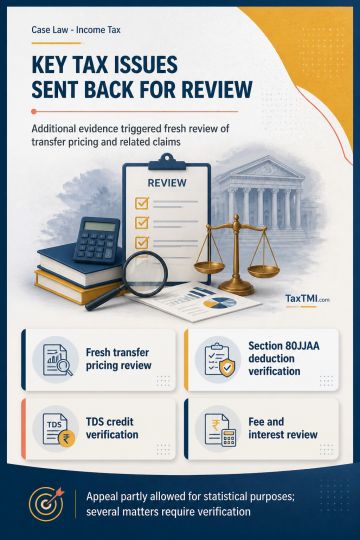
Additional evidence in transfer pricing dispute leads to fresh examination, while tax deductions, TDS credit, fee and refund interest require verifica...
Category II AIF pass-through taxation preserves non-business income character; investment receipts cannot be reclassified without applying recognised ...
Mutual fund maturity rules require proper rollover, redemption, disclosure, and due diligence; investor gains cannot excuse regulatory breaches or pen...
Page of 4798
Press 'Enter' after typing page number.
1161 to 1180 of 95957 Results
❮
❯
❯❯
0 / 200
Expand Note
Add to Folder
No Folders have been created
+
Are you sure you want to delete "My most important" ?
This case deals with the validity of assessment proceedings initiated against an amalgamated company for the assessment year 2018-19. The key points are: The Assessing Officer (AO) erroneously assumed jurisdiction u/ss 147/148/148A, alleging income had escaped assessment because the amalgamating company failed to file a return for AY 2018-19. However, the amalgamating company stood dissolved on March 30, 2018, and could not file a return. Only the amalgamated company was required to file, which it duly did. The consolidated accounts were assessed u/s 143(3). The AO failed to establish that items mentioned in the Section 148A(b) notice were not incorporated in the amalgamated company's accounts/return, resulting in escaped income. This vitiated the proceedings. The AO violated principles of natural justice by not granting an effective hearing despite requests. Section 148A(b) mandates granting an opportunity by issuing a show-cause notice with a minimum 7-day and maximum 30-day response period, extendable on application. Though the notice was issued on March 23, 2022, with a 7-day period, the AO improperly extended it to April 19, 2022, without an application. The Section 148 notice issued on April.
This case deals with the validity of assessment proceedings initiated against an amalgamated company for the assessment year 2018-19. The key points are: The Assessing Officer (AO) erroneously assumed jurisdiction u/ss 147/148/148A, alleging income had escaped assessment because the amalgamating company failed to file a return for AY 2018-19. However, the amalgamating company stood dissolved on March 30, 2018, and could not file a return. Only the amalgamated company was required to file, which it duly did. The consolidated accounts were assessed u/s 143(3). The AO failed to establish that items mentioned in the Section 148A(b) notice were not incorporated in the amalgamated company's accounts/return, resulting in escaped income. This vitiated the proceedings. The AO violated principles of natural justice by not granting an effective hearing despite requests. Section 148A(b) mandates granting an opportunity by issuing a show-cause notice with a minimum 7-day and maximum 30-day response period, extendable on application. Though the notice was issued on March 23, 2022, with a 7-day period, the AO improperly extended it to April 19, 2022, without an application. The Section 148 notice issued on April.
Note: It is a system-generated summary and is for quick reference only.
 TaxTMI
 of 4798

















 Join Channel


 TaxTMI