Development agreements require legal possession or effective enjoyment for capital gains transfer; permissive possession and deferred consideration de...
Prolonged sterilisation of development rights supports capital-gains treatment, while business-income disallowances cannot govern capital-gains comput...
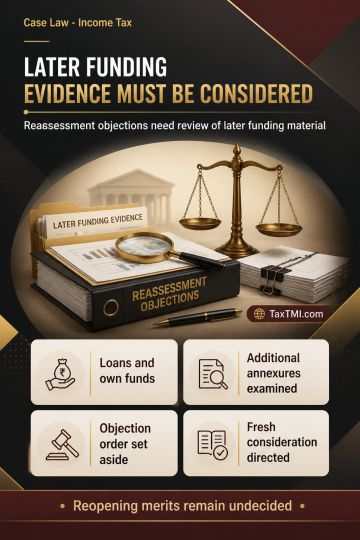
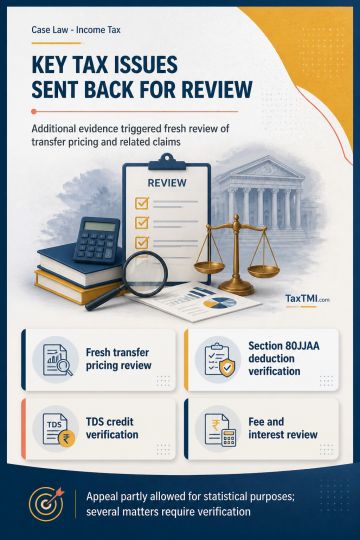
Additional evidence in transfer pricing dispute leads to fresh examination, while tax deductions, TDS credit, fee and refund interest require verifica...
Category II AIF pass-through taxation preserves non-business income character; investment receipts cannot be reclassified without applying recognised ...
Penalty levied u/s 271D for contravention of Section 269SS, which restricts cash transactions above a specified sum for immovable property. The key points are: The Assessing Officer (AO) failed to reconcile the assessment order and penalty order regarding the violation of Section 269SS. The penalty order should have referenced the AO's communication proposing the penalty initiation. The AO is required to record the satisfaction of Section 269SS violation and reference for penalty initiation in the assessment order itself. The interpretation of "specified sum" as a residuary term encompassing all cash transactions beyond a specified amount is incorrect. The amended Section 269SS applies to cash received as an advance for immovable property transactions, not to the final payment made at the time of registration and execution of the sale deed. The assessee had received cash against the sale of multiple registered sale deeds, not as an advance. Since the payment was made before the sub-registrar during registration, it does not violate Section 269SS. Consequently, the penalty levied u/s 271D is against the provisions of law and is quashed by the Appellate Tribunal.
Penalty levied u/s 271D for contravention of Section 269SS, which restricts cash transactions above a specified sum for immovable property. The key points are: The Assessing Officer (AO) failed to reconcile the assessment order and penalty order regarding the violation of Section 269SS. The penalty order should have referenced the AO's communication proposing the penalty initiation. The AO is required to record the satisfaction of Section 269SS violation and reference for penalty initiation in the assessment order itself. The interpretation of "specified sum" as a residuary term encompassing all cash transactions beyond a specified amount is incorrect. The amended Section 269SS applies to cash received as an advance for immovable property transactions, not to the final payment made at the time of registration and execution of the sale deed. The assessee had received cash against the sale of multiple registered sale deeds, not as an advance. Since the payment was made before the sub-registrar during registration, it does not violate Section 269SS. Consequently, the penalty levied u/s 271D is against the provisions of law and is quashed by the Appellate Tribunal.
Note: It is a system-generated summary and is for quick reference only.
 TaxTMI
 of 4800















 Join Channel


 TaxTMI
