Defined public benefit can retain charitable character; registration renewal requires examining genuine activities and legal compliance, not surplus a...
Capital reduction is distinct from share buy-back, preventing buy-back tax; restructuring interest and related business deductions also survive scruti...
Transfer pricing and tax deductions upheld on established principles, while employee contributions and warranty provisions returned for fresh examinat...
Captive transfer pricing relies on industrial consumer tariffs, while genuine quotations can benchmark effluent treatment transfers under the Other Me...
Specific tariff classification for ophthalmic instruments and extended limitation principles determine the treatment of duty demands, confiscation, an...
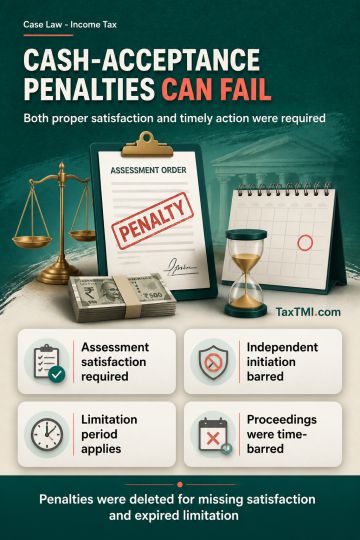
Penalty levied u/s 271D for contravention of Section 269SS, which restricts cash transactions above a specified sum for immovable property. The key points are: The Assessing Officer (AO) failed to reconcile the assessment order and penalty order regarding the violation of Section 269SS. The penalty order should have referenced the AO's communication proposing the penalty initiation. The AO is required to record the satisfaction of Section 269SS violation and reference for penalty initiation in the assessment order itself. The interpretation of "specified sum" as a residuary term encompassing all cash transactions beyond a specified amount is incorrect. The amended Section 269SS applies to cash received as an advance for immovable property transactions, not to the final payment made at the time of registration and execution of the sale deed. The assessee had received cash against the sale of multiple registered sale deeds, not as an advance. Since the payment was made before the sub-registrar during registration, it does not violate Section 269SS. Consequently, the penalty levied u/s 271D is against the provisions of law and is quashed by the Appellate Tribunal.
Penalty levied u/s 271D for contravention of Section 269SS, which restricts cash transactions above a specified sum for immovable property. The key points are: The Assessing Officer (AO) failed to reconcile the assessment order and penalty order regarding the violation of Section 269SS. The penalty order should have referenced the AO's communication proposing the penalty initiation. The AO is required to record the satisfaction of Section 269SS violation and reference for penalty initiation in the assessment order itself. The interpretation of "specified sum" as a residuary term encompassing all cash transactions beyond a specified amount is incorrect. The amended Section 269SS applies to cash received as an advance for immovable property transactions, not to the final payment made at the time of registration and execution of the sale deed. The assessee had received cash against the sale of multiple registered sale deeds, not as an advance. Since the payment was made before the sub-registrar during registration, it does not violate Section 269SS. Consequently, the penalty levied u/s 271D is against the provisions of law and is quashed by the Appellate Tribunal.
Note: It is a system-generated summary and is for quick reference only.
 TaxTMI
 of 4800















 Join Channel


 TaxTMI