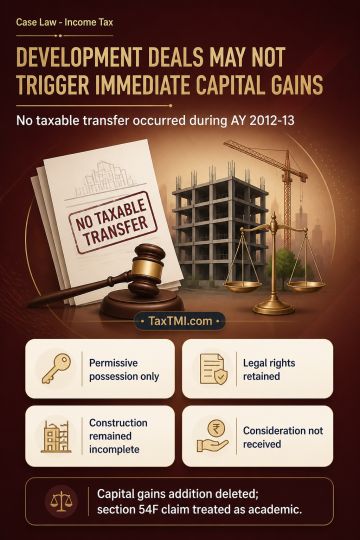
Development agreements require legal possession or effective enjoyment for capital gains transfer; permissive possession and deferred consideration de...
Prolonged sterilisation of development rights supports capital-gains treatment, while business-income disallowances cannot govern capital-gains comput...
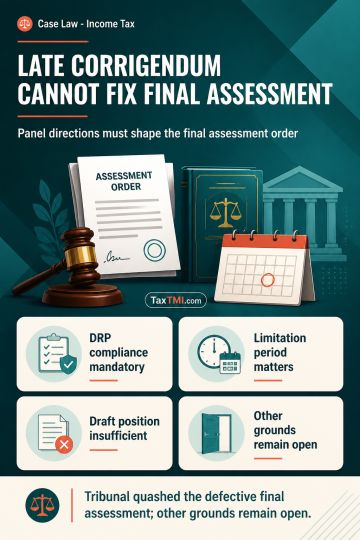
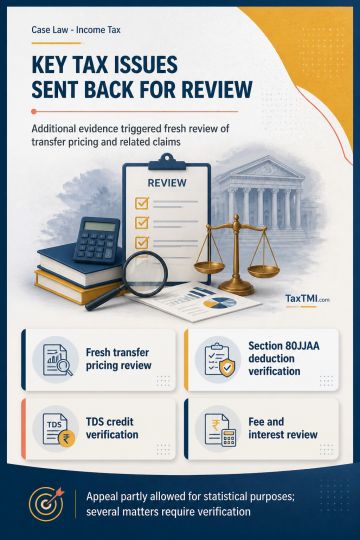
Additional evidence in transfer pricing dispute leads to fresh examination, while tax deductions, TDS credit, fee and refund interest require verifica...
Category II AIF pass-through taxation preserves non-business income character; investment receipts cannot be reclassified without applying recognised ...
The CESTAT held that the benefit of Notification No. 21/2016-CUS (ADD) dated 31.05.2016 is not to be provided to the appellant. The invocation of the extended period of limitation u/s 28(4) of the Customs Act, 1962, and the consequent imposition of penalty u/s 114A of the Act were examined. The CESTAT found that the dispute related to bills of entry filed on 24.10.2016, 27.10.2016, and 31.01.2017, but the show cause notice was issued on 20.10.2021. All the relevant information was available in the import invoice and bill of lading at the time of filing the bills of entry. There was no suppression of facts by the appellant. Therefore, the ingredients to invoke the extended period u/s 28(4) were not available. The demand for the bills of entry dated 24.10.2016, 27.10.2016, and 31.01.2017 was time-barred as the show cause notice was issued much after the normal period of limitation.
The CESTAT held that the benefit of Notification No. 21/2016-CUS (ADD) dated 31.05.2016 is not to be provided to the appellant. The invocation of the extended period of limitation u/s 28(4) of the Customs Act, 1962, and the consequent imposition of penalty u/s 114A of the Act were examined. The CESTAT found that the dispute related to bills of entry filed on 24.10.2016, 27.10.2016, and 31.01.2017, but the show cause notice was issued on 20.10.2021. All the relevant information was available in the import invoice and bill of lading at the time of filing the bills of entry. There was no suppression of facts by the appellant. Therefore, the ingredients to invoke the extended period u/s 28(4) were not available. The demand for the bills of entry dated 24.10.2016, 27.10.2016, and 31.01.2017 was time-barred as the show cause notice was issued much after the normal period of limitation.
Note: It is a system-generated summary and is for quick reference only.
 TaxTMI
 of 4800







 Join Channel


 TaxTMI
