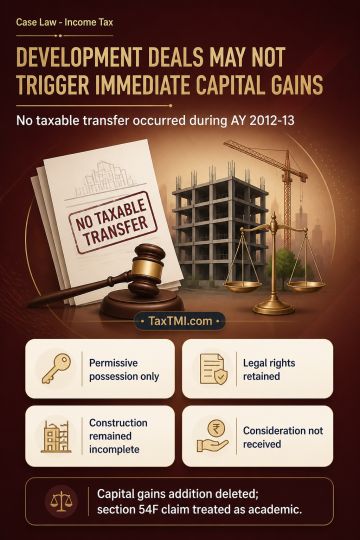
Development agreements require legal possession or effective enjoyment for capital gains transfer; permissive possession and deferred consideration de...
Prolonged sterilisation of development rights supports capital-gains treatment, while business-income disallowances cannot govern capital-gains comput...
Additional evidence in transfer pricing dispute leads to fresh examination, while tax deductions, TDS credit, fee and refund interest require verifica...
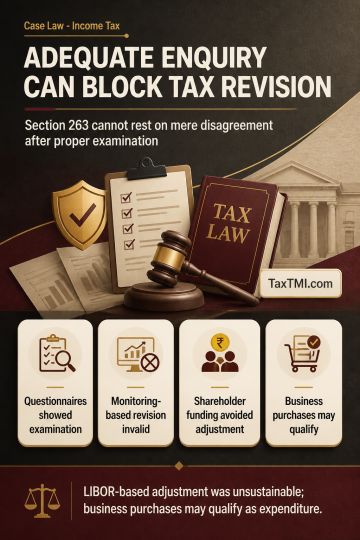
Category II AIF pass-through taxation preserves non-business income character; investment receipts cannot be reclassified without applying recognised ...
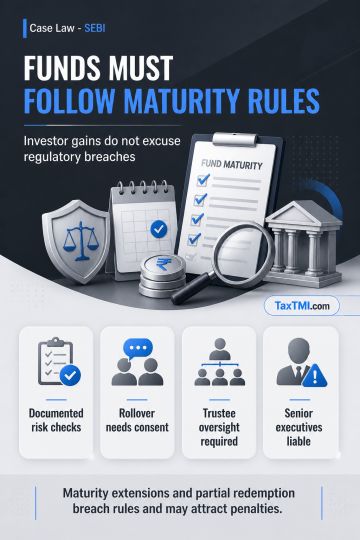
Mutual fund maturity rules require proper rollover, redemption, disclosure, and due diligence; investor gains cannot excuse regulatory breaches or pen...
Page of 4798
Press 'Enter' after typing page number.
1161 to 1180 of 95957 Results
❮
❯
❯❯
0 / 200
Expand Note
Add to Folder
No Folders have been created
+
Are you sure you want to delete "My most important" ?
The Supreme Court addressed two key issues: 1) Whether an application u/s 29A(4) of the Arbitration and Conciliation Act, 1996 for extension of the Arbitral Tribunal's mandate can be filed after the expiry of its mandate. The Court held that based on the wording of Section 29A(4) and its decision in Rohan Builders, an application for extension can be filed even after the termination of the Tribunal's mandate upon expiry of the statutory and extendable period. 2) Whether an extension should be granted in the present case. The Court held that considering the COVID-19 pandemic, the exclusion of the period from 15.03.2020 to 28.02.2023 from limitation periods, and the parties' agreement to seek extension, there was sufficient cause for granting extension. Accordingly, the High Court's order was set aside, and the civil appeal was allowed.
The Supreme Court addressed two key issues: 1) Whether an application u/s 29A(4) of the Arbitration and Conciliation Act, 1996 for extension of the Arbitral Tribunal's mandate can be filed after the expiry of its mandate. The Court held that based on the wording of Section 29A(4) and its decision in Rohan Builders, an application for extension can be filed even after the termination of the Tribunal's mandate upon expiry of the statutory and extendable period. 2) Whether an extension should be granted in the present case. The Court held that considering the COVID-19 pandemic, the exclusion of the period from 15.03.2020 to 28.02.2023 from limitation periods, and the parties' agreement to seek extension, there was sufficient cause for granting extension. Accordingly, the High Court's order was set aside, and the civil appeal was allowed.
Note: It is a system-generated summary and is for quick reference only.
 TaxTMI
 of 4798











 Join Channel


 TaxTMI