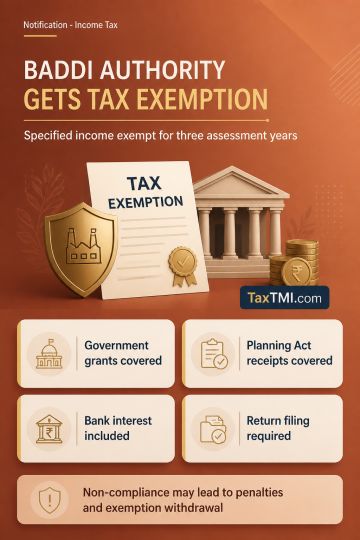
Specified income of Baddi Barotiwala Nalagarh Development Authority receives conditional tax exemption, retrospectively covering its designated assess...
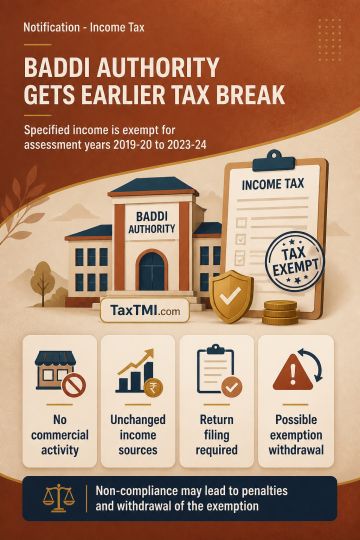
Specified development authority income receives retrospective tax exemption, subject to non-commercial activity, unchanged income sources, and return-...
Unified Brand India framework introduces voluntary Trust Mark certification and funding support for export branding, packaging and global promotional ...
Origin Declaration authentication governs preferential tariff claims under India-UK CETA, requiring a validated reference number before import clearan...
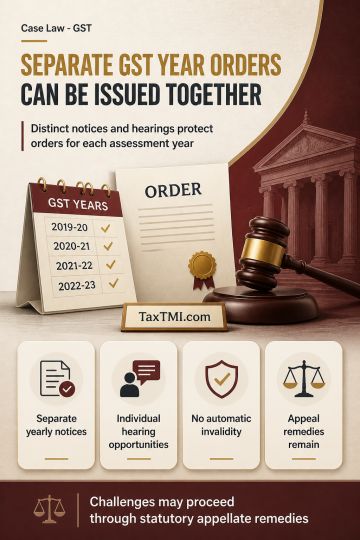
Separate assessment orders for different years remain valid when distinct notices and hearing opportunities prevent prejudice from combined proceeding...
The Supreme Court addressed two key issues: 1) Whether an application u/s 29A(4) of the Arbitration and Conciliation Act, 1996 for extension of the Arbitral Tribunal's mandate can be filed after the expiry of its mandate. The Court held that based on the wording of Section 29A(4) and its decision in Rohan Builders, an application for extension can be filed even after the termination of the Tribunal's mandate upon expiry of the statutory and extendable period. 2) Whether an extension should be granted in the present case. The Court held that considering the COVID-19 pandemic, the exclusion of the period from 15.03.2020 to 28.02.2023 from limitation periods, and the parties' agreement to seek extension, there was sufficient cause for granting extension. Accordingly, the High Court's order was set aside, and the civil appeal was allowed.
The Supreme Court addressed two key issues: 1) Whether an application u/s 29A(4) of the Arbitration and Conciliation Act, 1996 for extension of the Arbitral Tribunal's mandate can be filed after the expiry of its mandate. The Court held that based on the wording of Section 29A(4) and its decision in Rohan Builders, an application for extension can be filed even after the termination of the Tribunal's mandate upon expiry of the statutory and extendable period. 2) Whether an extension should be granted in the present case. The Court held that considering the COVID-19 pandemic, the exclusion of the period from 15.03.2020 to 28.02.2023 from limitation periods, and the parties' agreement to seek extension, there was sufficient cause for granting extension. Accordingly, the High Court's order was set aside, and the civil appeal was allowed.
Note: It is a system-generated summary and is for quick reference only.
 TaxTMI
 of 4798







 Join Channel


 TaxTMI

