Cooperative society deposits, member-interest TDS exemption and credit-facility deduction claims require verification through records and supporting e...
Customs jurisdiction over EPCG condition breaches survives export-obligation discharge certificates, requiring alleged fraud and misdeclaration to be ...
Contractual tolerance requires consideration; breach recoveries, qualifying public infrastructure services and road works escape service tax liability...
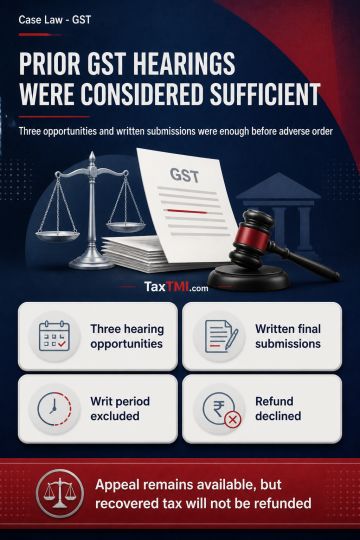
Personal hearing requirements in GST adjudication were satisfied by prior opportunities and written submissions; appellate limitation received writ-pe...
Locus standi of the appellant to prefer the appeal, the applicability of Section 195(1)(b) CrPC, and the correctness of the High Court's order for de novo proceedings against the appellant. The Supreme Court held that the appellant has locus standi as the case involves serious allegations of interference with judicial processes. It ruled that the proceedings were not hit by the bar u/s 195(1)(b) CrPC as the initiation arose from a court order and not a private complaint. Regarding de novo proceedings, the Court stated that the High Court erred in quashing the criminal proceedings and ordering a fresh trial, as the alleged forgery of evidence leading to acquittal warranted further investigation. Consequently, the impugned order was set aside, and the appeal was allowed.
Locus standi of the appellant to prefer the appeal, the applicability of Section 195(1)(b) CrPC, and the correctness of the High Court's order for de novo proceedings against the appellant. The Supreme Court held that the appellant has locus standi as the case involves serious allegations of interference with judicial processes. It ruled that the proceedings were not hit by the bar u/s 195(1)(b) CrPC as the initiation arose from a court order and not a private complaint. Regarding de novo proceedings, the Court stated that the High Court erred in quashing the criminal proceedings and ordering a fresh trial, as the alleged forgery of evidence leading to acquittal warranted further investigation. Consequently, the impugned order was set aside, and the appeal was allowed.
Note: It is a system-generated summary and is for quick reference only.
 TaxTMI
 of 4792




















 Join Channel


 TaxTMI