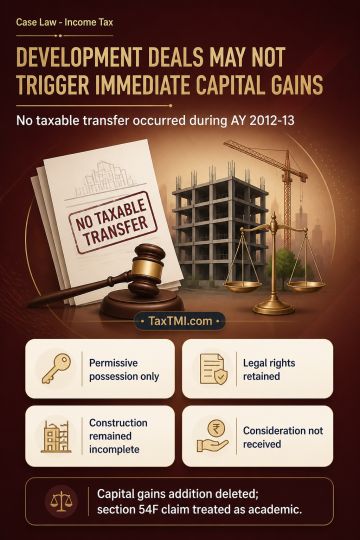
Development agreements require legal possession or effective enjoyment for capital gains transfer; permissive possession and deferred consideration de...
Prolonged sterilisation of development rights supports capital-gains treatment, while business-income disallowances cannot govern capital-gains comput...
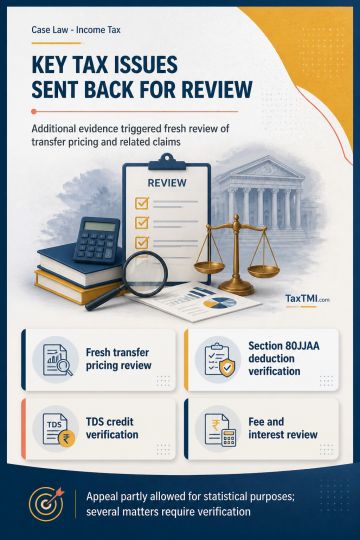
Additional evidence in transfer pricing dispute leads to fresh examination, while tax deductions, TDS credit, fee and refund interest require verifica...
Category II AIF pass-through taxation preserves non-business income character; investment receipts cannot be reclassified without applying recognised ...
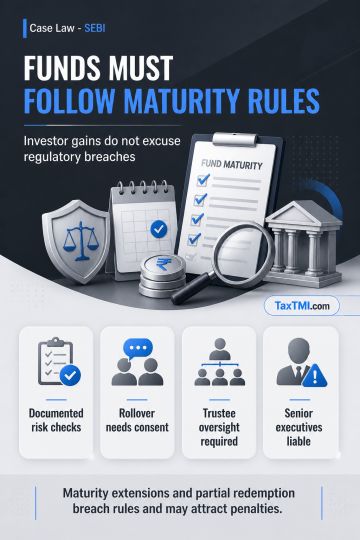
Mutual fund maturity rules require proper rollover, redemption, disclosure, and due diligence; investor gains cannot excuse regulatory breaches or pen...
Page of 4798
Press 'Enter' after typing page number.
1161 to 1180 of 95957 Results
❮
❯
❯❯
0 / 200
Expand Note
Add to Folder
No Folders have been created
+
Are you sure you want to delete "My most important" ?
Misappropriation of funds by an employee led to the assessee claiming expenses u/s 37(1) of the Act, which were later discovered to be embezzlement. The assessee suffered a loss due to the employee's fraudulent actions. The CBDT Circular No. 35-D states that losses arising from embezzlement are allowable u/s 28(i) of the Act. The revenue contended that the claim should be u/s 28 instead of Section 37(1). The assessee offered the recovered amount of Rs. 229 lakhs to tax but had not recovered the impugned amount during the assessment year. The addition was unjustified as the debited amount, though not fulfilling Section 37(1) expenses, was related to an allowable embezzlement loss. Relying on Bombay Forgings Pvt Ltd and G.G. Dandekar Machine Works Ltd cases, the assessee was eligible for deduction due to embezzlement loss. The Appellate Tribunal ruled in favor of the assessee as the revenue failed to prove recovery during the assessment year.
Misappropriation of funds by an employee led to the assessee claiming expenses u/s 37(1) of the Act, which were later discovered to be embezzlement. The assessee suffered a loss due to the employee's fraudulent actions. The CBDT Circular No. 35-D states that losses arising from embezzlement are allowable u/s 28(i) of the Act. The revenue contended that the claim should be u/s 28 instead of Section 37(1). The assessee offered the recovered amount of Rs. 229 lakhs to tax but had not recovered the impugned amount during the assessment year. The addition was unjustified as the debited amount, though not fulfilling Section 37(1) expenses, was related to an allowable embezzlement loss. Relying on Bombay Forgings Pvt Ltd and G.G. Dandekar Machine Works Ltd cases, the assessee was eligible for deduction due to embezzlement loss. The Appellate Tribunal ruled in favor of the assessee as the revenue failed to prove recovery during the assessment year.
Note: It is a system-generated summary and is for quick reference only.
 TaxTMI
 of 4798












 Join Channel


 TaxTMI