Transfer pricing and tax deductions upheld on established principles, while employee contributions and warranty provisions returned for fresh examinat...
Captive transfer pricing relies on industrial consumer tariffs, while genuine quotations can benchmark effluent treatment transfers under the Other Me...
Specific tariff classification for ophthalmic instruments and extended limitation principles determine the treatment of duty demands, confiscation, an...
Integrated golf function determines classification, placing launch monitors and simulators under other golf equipment rather than measuring instrument...
Public servant status under anti-corruption law extends to recognised stock exchange leadership; constitutional and sanction challenges do not succeed...
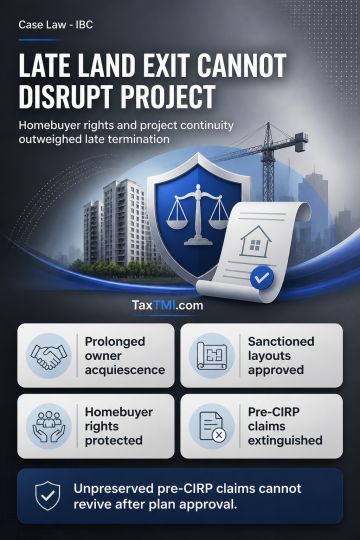
Acquiescence, homebuyer protection and clean-slate resolution principles prevent landowners from disrupting an integrated project through late termina...
Page of 4792
Press 'Enter' after typing page number.
1001 to 1020 of 95833 Results
❮
❯
❯❯
0 / 200
Expand Note
Add to Folder
No Folders have been created
+
Are you sure you want to delete "My most important" ?
The Appellate Tribunal held that the Commissioner of Income Tax (Exemptions) erred in rejecting the trust's registration u/s 12AA. The trust's objects were not found to be profit-oriented, and no activity was conducted against its objects. The events organized by an individual could not be attributed to the trust, especially when no expenses were incurred, as per the Income and Expenditure statements. The Supreme Court's decision clarified that an entity advancing general public utility cannot engage in trade, commerce, or business for consideration. However, the Delhi High Court upheld the constitutional validity of the proviso to Section 2(15), applying where the dominant intention is profit-making. Since nothing suggested the trust's objects were profit-oriented, the order rejecting registration was set aside, and the Commissioner was directed to register the trust in accordance with the law.
The Appellate Tribunal held that the Commissioner of Income Tax (Exemptions) erred in rejecting the trust's registration u/s 12AA. The trust's objects were not found to be profit-oriented, and no activity was conducted against its objects. The events organized by an individual could not be attributed to the trust, especially when no expenses were incurred, as per the Income and Expenditure statements. The Supreme Court's decision clarified that an entity advancing general public utility cannot engage in trade, commerce, or business for consideration. However, the Delhi High Court upheld the constitutional validity of the proviso to Section 2(15), applying where the dominant intention is profit-making. Since nothing suggested the trust's objects were profit-oriented, the order rejecting registration was set aside, and the Commissioner was directed to register the trust in accordance with the law.
Note: It is a system-generated summary and is for quick reference only.
 TaxTMI
 of 4792


















 Join Channel


 TaxTMI