Development agreements require legal possession or effective enjoyment for capital gains transfer; permissive possession and deferred consideration de...
Prolonged sterilisation of development rights supports capital-gains treatment, while business-income disallowances cannot govern capital-gains comput...
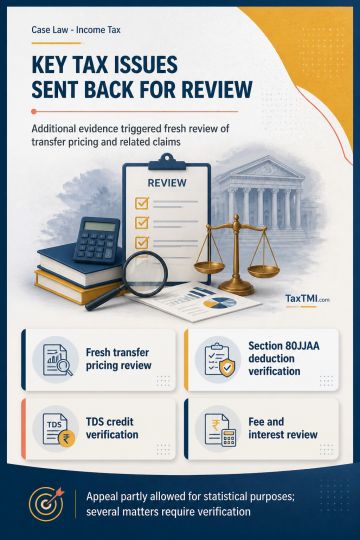
Additional evidence in transfer pricing dispute leads to fresh examination, while tax deductions, TDS credit, fee and refund interest require verifica...
Category II AIF pass-through taxation preserves non-business income character; investment receipts cannot be reclassified without applying recognised ...
Mutual fund maturity rules require proper rollover, redemption, disclosure, and due diligence; investor gains cannot excuse regulatory breaches or pen...
Page of 4798
Press 'Enter' after typing page number.
1161 to 1180 of 95957 Results
❮
❯
❯❯
0 / 200
Expand Note
Add to Folder
No Folders have been created
+
Are you sure you want to delete "My most important" ?
Interplay between Sections 153C and 147 of the Income Tax Act, specifically whether recourse to Section 147 is available when the Assessing Officer (AO) is empowered to proceed u/s 153C. It was held that Section 153C enables the AO to assess or reassess income where incriminating assets, material, or documents are found during a search u/s 132 or requisition u/s 132A in respect of another person. However, in the present case, the jurisdictional conditions to initiate proceedings u/s 153C were not satisfied as the AO of the searched person did not record a satisfaction note and transmit relevant material to the Assessee's AO. The reassessment proceedings were initiated u/s 147 based on information received from the Investigation Wing regarding the Assessee's purchase of penny stock units. Since the AO did not assume jurisdiction u/s 153C, the non-obstante clause of Section 153C would not override Sections 147, 148, and 149, and the decision to reassess u/s 147 was upheld.
Interplay between Sections 153C and 147 of the Income Tax Act, specifically whether recourse to Section 147 is available when the Assessing Officer (AO) is empowered to proceed u/s 153C. It was held that Section 153C enables the AO to assess or reassess income where incriminating assets, material, or documents are found during a search u/s 132 or requisition u/s 132A in respect of another person. However, in the present case, the jurisdictional conditions to initiate proceedings u/s 153C were not satisfied as the AO of the searched person did not record a satisfaction note and transmit relevant material to the Assessee's AO. The reassessment proceedings were initiated u/s 147 based on information received from the Investigation Wing regarding the Assessee's purchase of penny stock units. Since the AO did not assume jurisdiction u/s 153C, the non-obstante clause of Section 153C would not override Sections 147, 148, and 149, and the decision to reassess u/s 147 was upheld.
Note: It is a system-generated summary and is for quick reference only.
 TaxTMI
 of 4798












 Join Channel


 TaxTMI