Additional evidence in transfer pricing dispute leads to fresh examination, while tax deductions, TDS credit, fee and refund interest require verifica...
Category II AIF pass-through taxation preserves non-business income character; investment receipts cannot be reclassified without applying recognised ...
Mutual fund maturity rules require proper rollover, redemption, disclosure, and due diligence; investor gains cannot excuse regulatory breaches or pen...
Threshold exemption excludes exempt services, while stamp-paper purchases avoid reverse charge; consequential service tax penalties were also set asid...
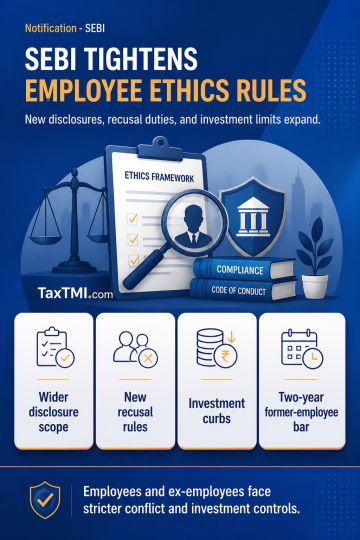
Employee conflict disclosures and investment restrictions expand with new recusal duties, post-employment limits, and compliance reporting requirement...
The core issue pertains to the appropriate customs tariff classification of 'Integrated Circuit Micro Electro Mechanical System Microphones' imported by the appellant. The court held that despite the product's description, its primary identity is that of a microphone enhanced by MEMS technology, rather than an integrated circuit (IC). The court opined that the product's classification is determined by its function as a microphone, not the underlying technology used. While MEMS technology enhances the microphone's capabilities, it does not change its fundamental nature. The court distinguished this case from scenarios where standalone ICs or MEMS sensors are imported, as the product in question is a fully assembled MEMS microphone with integrated components. Consequently, the court ruled that classifying the product under Customs Tariff Heading 8518 as a microphone, rather than under Heading 8542 as an electronic integrated circuit, is appropriate based on the Customs Tariff Act, Harmonized System nomenclature, and relevant explanatory notes.
The core issue pertains to the appropriate customs tariff classification of 'Integrated Circuit Micro Electro Mechanical System Microphones' imported by the appellant. The court held that despite the product's description, its primary identity is that of a microphone enhanced by MEMS technology, rather than an integrated circuit (IC). The court opined that the product's classification is determined by its function as a microphone, not the underlying technology used. While MEMS technology enhances the microphone's capabilities, it does not change its fundamental nature. The court distinguished this case from scenarios where standalone ICs or MEMS sensors are imported, as the product in question is a fully assembled MEMS microphone with integrated components. Consequently, the court ruled that classifying the product under Customs Tariff Heading 8518 as a microphone, rather than under Heading 8542 as an electronic integrated circuit, is appropriate based on the Customs Tariff Act, Harmonized System nomenclature, and relevant explanatory notes.
Note: It is a system-generated summary and is for quick reference only.
 TaxTMI
 of 4803

















 Join Channel


 TaxTMI
