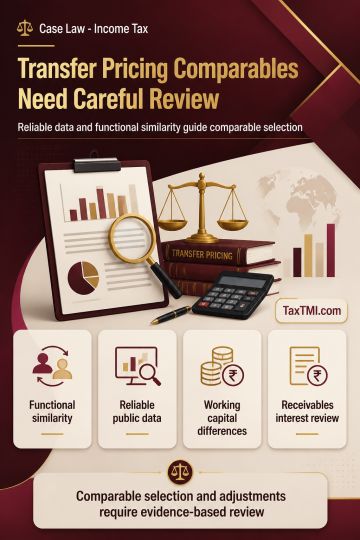
Transfer pricing comparability requires functional alignment, reliable financial data, and careful review of working capital and receivables adjustmen...
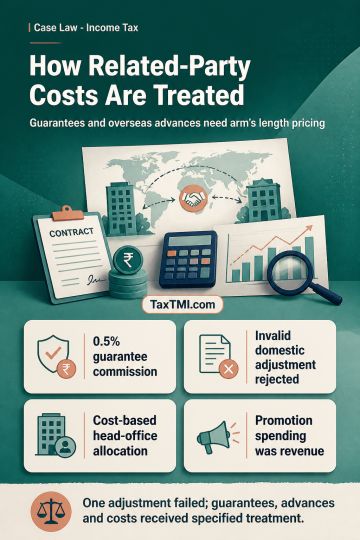
Transfer pricing rules require benchmarking corporate guarantees and associated-enterprise advances, while invalid domestic-transaction adjustments ca...
Prospective sugar export prohibition required registered letters of credit; private contracts and export quotas created no enforceable continuation ri...
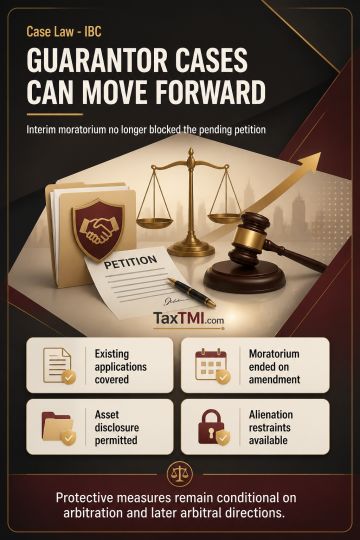
Retroactive interim-moratorium exclusion permits protective asset disclosure and preservation measures against personal guarantors pending arbitration...
The core issue pertains to the appropriate customs tariff classification of 'Integrated Circuit Micro Electro Mechanical System Microphones' imported by the appellant. The court held that despite the product's description, its primary identity is that of a microphone enhanced by MEMS technology, rather than an integrated circuit (IC). The court opined that the product's classification is determined by its function as a microphone, not the underlying technology used. While MEMS technology enhances the microphone's capabilities, it does not change its fundamental nature. The court distinguished this case from scenarios where standalone ICs or MEMS sensors are imported, as the product in question is a fully assembled MEMS microphone with integrated components. Consequently, the court ruled that classifying the product under Customs Tariff Heading 8518 as a microphone, rather than under Heading 8542 as an electronic integrated circuit, is appropriate based on the Customs Tariff Act, Harmonized System nomenclature, and relevant explanatory notes.
The core issue pertains to the appropriate customs tariff classification of 'Integrated Circuit Micro Electro Mechanical System Microphones' imported by the appellant. The court held that despite the product's description, its primary identity is that of a microphone enhanced by MEMS technology, rather than an integrated circuit (IC). The court opined that the product's classification is determined by its function as a microphone, not the underlying technology used. While MEMS technology enhances the microphone's capabilities, it does not change its fundamental nature. The court distinguished this case from scenarios where standalone ICs or MEMS sensors are imported, as the product in question is a fully assembled MEMS microphone with integrated components. Consequently, the court ruled that classifying the product under Customs Tariff Heading 8518 as a microphone, rather than under Heading 8542 as an electronic integrated circuit, is appropriate based on the Customs Tariff Act, Harmonized System nomenclature, and relevant explanatory notes.
Note: It is a system-generated summary and is for quick reference only.
 TaxTMI
 of 4792









 Join Channel


 TaxTMI