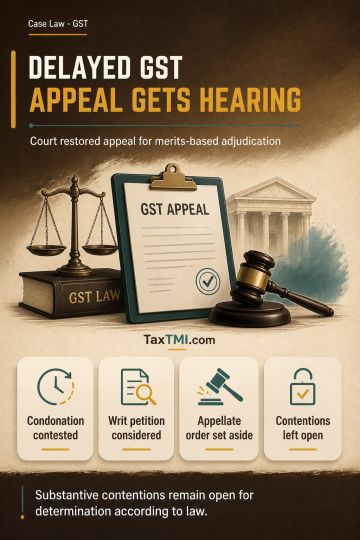
Necessary-party requirements limit impleadment of independent entities, while deferred consideration does not create an appealable adverse determinati...
Food supplement classification requires common parlance and authoritative tests, preventing treatment as proprietary Ayurvedic medicines without suppo...
Specified regulatory authority income receives conditional tax exemption, subject to non-commercial activity, unchanged income character, and return f...
Tax exemption for regulatory authority income applies retrospectively, subject to non-commercial activity, unchanged income sources, and return-filing...
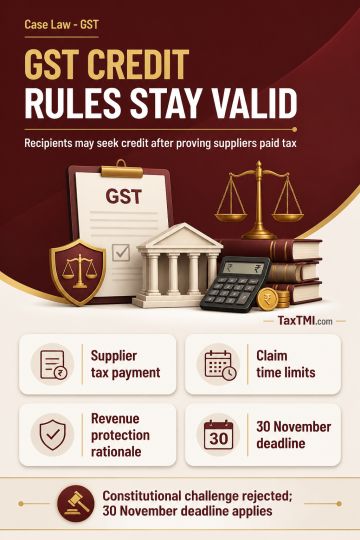
Input tax credit conditions remain constitutionally valid, with eligible recipient claims considered under GST circulars and retrospective filing dead...
A legal challenge was raised regarding the requirement to pay the Social Welfare Surcharge (SWS) on imported goods when the basic customs and additional duty were exempted through a scrip. The court examined Section 110 of the Finance Act, 2018, which levies SWS at 10% on the aggregate of duties collected under the Customs Act. The petitioner argued that since no customs duty was paid due to the exemption, the SWS, being a percentage of the duty paid, should also be zero. The court agreed with this reasoning, distinguishing it from previous cases on NCCD where the issue was the absence of a notification for levy. The court held that upon obtaining an exemption, the liability to pay duty is discharged, and no duty collection follows the levy. Consequently, if the duty paid is zero, the SWS, calculated as a percentage of the duty paid, must also be zero. The court granted a declaration that the petitioner is not required to pay SWS on customs duty exempted under the scrip.
A legal challenge was raised regarding the requirement to pay the Social Welfare Surcharge (SWS) on imported goods when the basic customs and additional duty were exempted through a scrip. The court examined Section 110 of the Finance Act, 2018, which levies SWS at 10% on the aggregate of duties collected under the Customs Act. The petitioner argued that since no customs duty was paid due to the exemption, the SWS, being a percentage of the duty paid, should also be zero. The court agreed with this reasoning, distinguishing it from previous cases on NCCD where the issue was the absence of a notification for levy. The court held that upon obtaining an exemption, the liability to pay duty is discharged, and no duty collection follows the levy. Consequently, if the duty paid is zero, the SWS, calculated as a percentage of the duty paid, must also be zero. The court granted a declaration that the petitioner is not required to pay SWS on customs duty exempted under the scrip.
Note: It is a system-generated summary and is for quick reference only.
 TaxTMI
 of 4792















 Join Channel


 TaxTMI