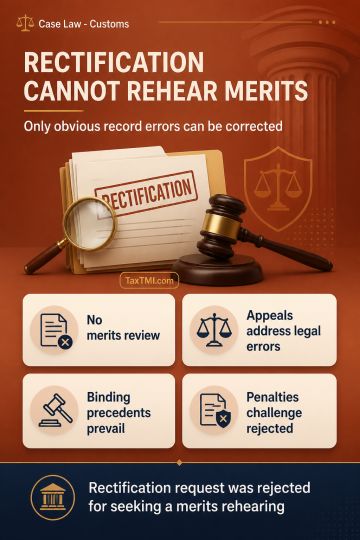
Rectification of mistake remains limited to self-evident record errors, preventing merits review through miscellaneous applications and preserving fin...
Tender creditworthiness conditions may extend to de facto Promoter Directors, with post-participation challenges generally barred absent arbitrariness...
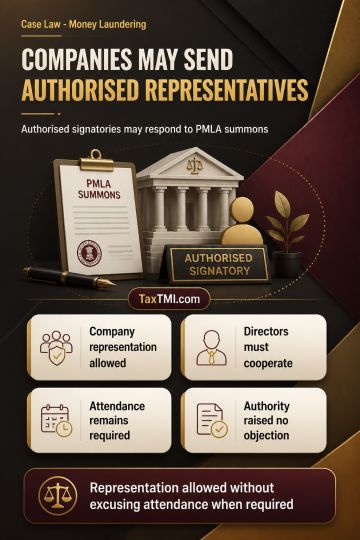
Corporate representation in PMLA summons proceedings permitted through an authorised signatory, subject to directors' continuing cooperation and atten...
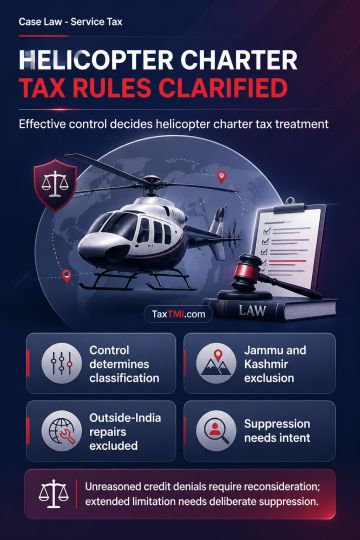
Helicopter charter classification requires effective control analysis, while territorial performance, reasoned credit orders and wilful suppression de...
Page of 4796
Press 'Enter' after typing page number.
781 to 800 of 95918 Results
❮
❯
❯❯
0 / 200
Expand Note
Add to Folder
No Folders have been created
+
Are you sure you want to delete "My most important" ?
The NCLAT held that disputes related to shareholder oppression or mismanagement under the Companies Act are distinct from the Insolvency and Bankruptcy Code (IBC) and fall outside its purview. As a special statute, the IBC prevails over the Companies Act pursuant to Section 238. The appellant's contention regarding resolution of the Company Petition u/ss 241 & 242 of the Companies Act before the CIRP petition was rejected. The NCLT order complied with the IBC provisions, and there was no pleading of pre-existing dispute. Equity shareholders, as owners, are beneficiaries when the company performs well but lose their capital in liquidation. While erstwhile directors can intervene and file appeals u/s 61, individual or majority shareholders cannot pursue derivative action. The appellant's argument that the definition of 'aggrieved person' u/s 61 should include any party whose interests are impacted was rejected, as a restrictive interpretation is warranted. The appellant, being a shareholder, is not an "aggrieved party" under the IBC and has no locus to file this appeal, leading to its dismissal.
The NCLAT held that disputes related to shareholder oppression or mismanagement under the Companies Act are distinct from the Insolvency and Bankruptcy Code (IBC) and fall outside its purview. As a special statute, the IBC prevails over the Companies Act pursuant to Section 238. The appellant's contention regarding resolution of the Company Petition u/ss 241 & 242 of the Companies Act before the CIRP petition was rejected. The NCLT order complied with the IBC provisions, and there was no pleading of pre-existing dispute. Equity shareholders, as owners, are beneficiaries when the company performs well but lose their capital in liquidation. While erstwhile directors can intervene and file appeals u/s 61, individual or majority shareholders cannot pursue derivative action. The appellant's argument that the definition of 'aggrieved person' u/s 61 should include any party whose interests are impacted was rejected, as a restrictive interpretation is warranted. The appellant, being a shareholder, is not an "aggrieved party" under the IBC and has no locus to file this appeal, leading to its dismissal.
Note: It is a system-generated summary and is for quick reference only.
 TaxTMI
 of 4796













 Join Channel


 TaxTMI