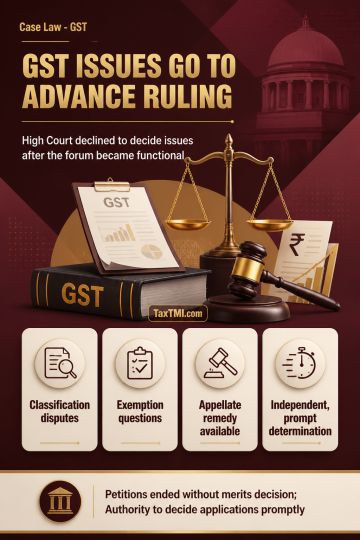
Advance-ruling mechanism governs pending GST classification, exemption and taxability disputes, limiting writ review once the specialised forum functi...
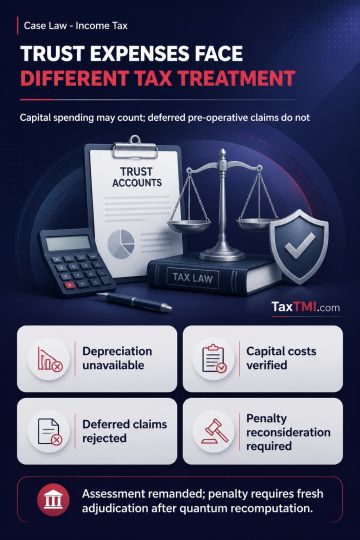
Charitable trust income application permits verified capital expenditure but rejects deferred pre-operative claims and requires reconsideration of con...
Reinsurance premium deductions require established regulatory breaches, while independently acquired software qualifies within the computer depreciati...
Page of 4796
Press 'Enter' after typing page number.
761 to 780 of 95918 Results
❮
❯
❯❯
0 / 200
Expand Note
Add to Folder
No Folders have been created
+
Are you sure you want to delete "My most important" ?
The NCLAT held that disputes related to shareholder oppression or mismanagement under the Companies Act are distinct from the Insolvency and Bankruptcy Code (IBC) and fall outside its purview. As a special statute, the IBC prevails over the Companies Act pursuant to Section 238. The appellant's contention regarding resolution of the Company Petition u/ss 241 & 242 of the Companies Act before the CIRP petition was rejected. The NCLT order complied with the IBC provisions, and there was no pleading of pre-existing dispute. Equity shareholders, as owners, are beneficiaries when the company performs well but lose their capital in liquidation. While erstwhile directors can intervene and file appeals u/s 61, individual or majority shareholders cannot pursue derivative action. The appellant's argument that the definition of 'aggrieved person' u/s 61 should include any party whose interests are impacted was rejected, as a restrictive interpretation is warranted. The appellant, being a shareholder, is not an "aggrieved party" under the IBC and has no locus to file this appeal, leading to its dismissal.
The NCLAT held that disputes related to shareholder oppression or mismanagement under the Companies Act are distinct from the Insolvency and Bankruptcy Code (IBC) and fall outside its purview. As a special statute, the IBC prevails over the Companies Act pursuant to Section 238. The appellant's contention regarding resolution of the Company Petition u/ss 241 & 242 of the Companies Act before the CIRP petition was rejected. The NCLT order complied with the IBC provisions, and there was no pleading of pre-existing dispute. Equity shareholders, as owners, are beneficiaries when the company performs well but lose their capital in liquidation. While erstwhile directors can intervene and file appeals u/s 61, individual or majority shareholders cannot pursue derivative action. The appellant's argument that the definition of 'aggrieved person' u/s 61 should include any party whose interests are impacted was rejected, as a restrictive interpretation is warranted. The appellant, being a shareholder, is not an "aggrieved party" under the IBC and has no locus to file this appeal, leading to its dismissal.
Note: It is a system-generated summary and is for quick reference only.
 TaxTMI
 of 4796
















 Join Channel


 TaxTMI