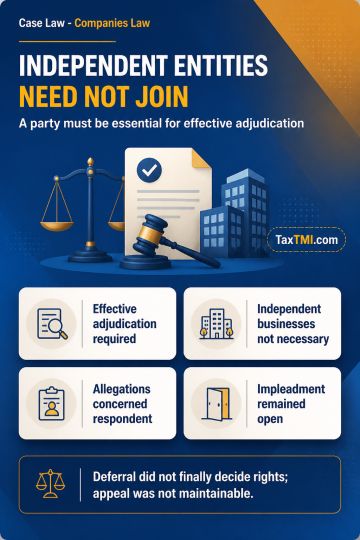
Necessary-party requirements limit impleadment of independent entities, while deferred consideration does not create an appealable adverse determinati...
Food supplement classification requires common parlance and authoritative tests, preventing treatment as proprietary Ayurvedic medicines without suppo...
Specified regulatory authority income receives conditional tax exemption, subject to non-commercial activity, unchanged income character, and return f...
Tax exemption for regulatory authority income applies retrospectively, subject to non-commercial activity, unchanged income sources, and return-filing...
Input tax credit conditions remain constitutionally valid, with eligible recipient claims considered under GST circulars and retrospective filing dead...
The NCLAT held that disputes related to shareholder oppression or mismanagement under the Companies Act are distinct from the Insolvency and Bankruptcy Code (IBC) and fall outside its purview. As a special statute, the IBC prevails over the Companies Act pursuant to Section 238. The appellant's contention regarding resolution of the Company Petition u/ss 241 & 242 of the Companies Act before the CIRP petition was rejected. The NCLT order complied with the IBC provisions, and there was no pleading of pre-existing dispute. Equity shareholders, as owners, are beneficiaries when the company performs well but lose their capital in liquidation. While erstwhile directors can intervene and file appeals u/s 61, individual or majority shareholders cannot pursue derivative action. The appellant's argument that the definition of 'aggrieved person' u/s 61 should include any party whose interests are impacted was rejected, as a restrictive interpretation is warranted. The appellant, being a shareholder, is not an "aggrieved party" under the IBC and has no locus to file this appeal, leading to its dismissal.
The NCLAT held that disputes related to shareholder oppression or mismanagement under the Companies Act are distinct from the Insolvency and Bankruptcy Code (IBC) and fall outside its purview. As a special statute, the IBC prevails over the Companies Act pursuant to Section 238. The appellant's contention regarding resolution of the Company Petition u/ss 241 & 242 of the Companies Act before the CIRP petition was rejected. The NCLT order complied with the IBC provisions, and there was no pleading of pre-existing dispute. Equity shareholders, as owners, are beneficiaries when the company performs well but lose their capital in liquidation. While erstwhile directors can intervene and file appeals u/s 61, individual or majority shareholders cannot pursue derivative action. The appellant's argument that the definition of 'aggrieved person' u/s 61 should include any party whose interests are impacted was rejected, as a restrictive interpretation is warranted. The appellant, being a shareholder, is not an "aggrieved party" under the IBC and has no locus to file this appeal, leading to its dismissal.
Note: It is a system-generated summary and is for quick reference only.
 TaxTMI
 of 4792




















 Join Channel


 TaxTMI

