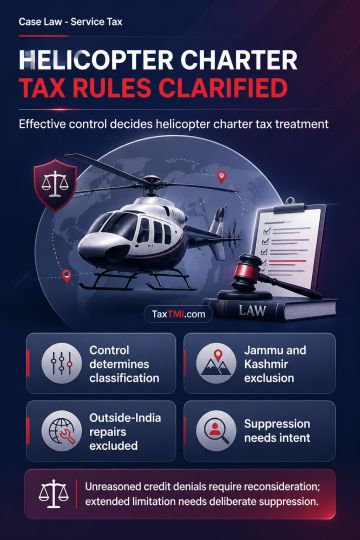
Helicopter charter classification requires effective control analysis, while territorial performance, reasoned credit orders and wilful suppression de...
Specified fund definition expands PAN exemption eligibility for registered alternative investment funds and qualifying International Financial Service...
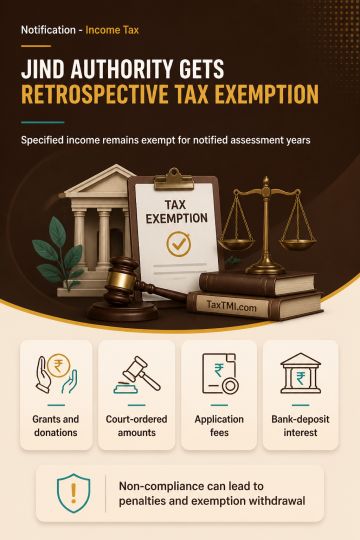
Tax exemption for specified legal-services authority income applies retrospectively, subject to non-commercial activity, unchanged income sources, and...
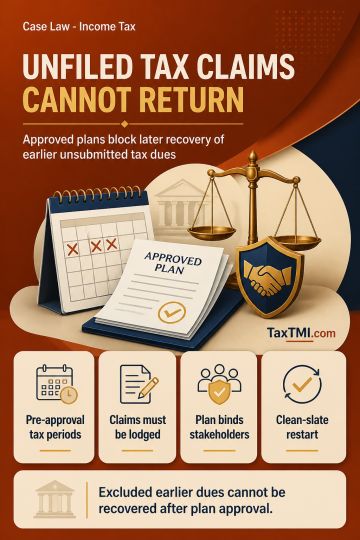
Approved resolution plans extinguish unsubmitted pre-approval tax claims, preventing later recovery outside the insolvency process and preserving a cl...
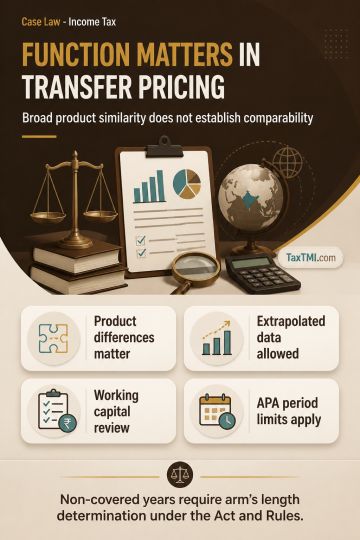
Transfer pricing comparability requires functional alignment and permits working capital adjustment, while APA margins cannot govern non-covered years...
Page of 4800
Press 'Enter' after typing page number.
881 to 900 of 95999 Results
❮
❯
❯❯
0 / 200
Expand Note
Add to Folder
No Folders have been created
+
Are you sure you want to delete "My most important" ?
Mobile service providers (MSPs) can claim CENVAT credit on excise duties paid on mobile towers and prefabricated buildings (PFBs) used for providing output services. Mobile towers and PFBs qualify as "capital goods" or "inputs" under the CENVAT Rules, enabling MSPs to claim credit. The Supreme Court applied the "marketability test" to determine movability, ruling that if goods can be dismantled, relocated without damage, and sold in the market, they retain mobility and qualify as movable property, not immovable. Towers and PFBs meet this test as they can be dismantled, relocated, and sold without losing their essential character. PFBs, housing BTS equipment and power backup, are accessories to antennas and BTS, which are capital goods. Therefore, towers and PFBs are "goods" and "inputs" under CENVAT Rules, allowing MSPs to claim credit on duties paid.
Mobile service providers (MSPs) can claim CENVAT credit on excise duties paid on mobile towers and prefabricated buildings (PFBs) used for providing output services. Mobile towers and PFBs qualify as "capital goods" or "inputs" under the CENVAT Rules, enabling MSPs to claim credit. The Supreme Court applied the "marketability test" to determine movability, ruling that if goods can be dismantled, relocated without damage, and sold in the market, they retain mobility and qualify as movable property, not immovable. Towers and PFBs meet this test as they can be dismantled, relocated, and sold without losing their essential character. PFBs, housing BTS equipment and power backup, are accessories to antennas and BTS, which are capital goods. Therefore, towers and PFBs are "goods" and "inputs" under CENVAT Rules, allowing MSPs to claim credit on duties paid.
Note: It is a system-generated summary and is for quick reference only.
 TaxTMI
 of 4800








 Join Channel


 TaxTMI