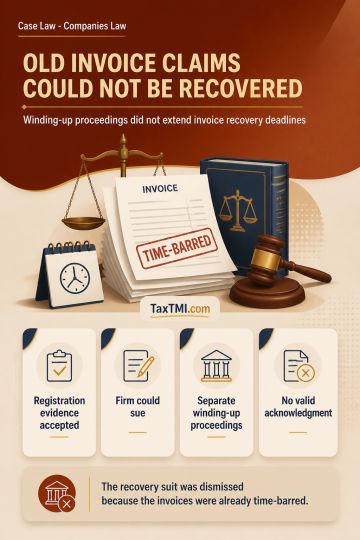
Invoice-based recovery claims remain time-barred despite separate winding-up proceedings, absent valid acknowledgment or part-payment of the disputed ...
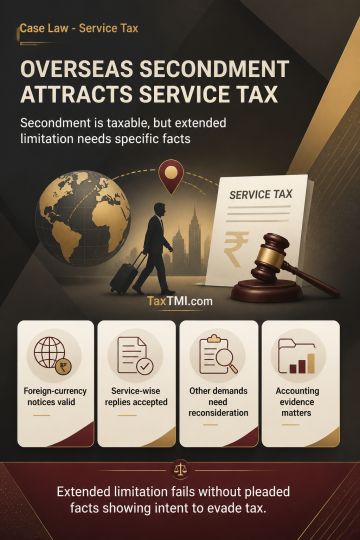
Extended limitation fails without specific suppression allegations, while overseas employee secondment remains taxable as manpower supply within norma...
Time-share accommodation classification excludes Club or Association Service where purchasers receive contractual occupancy rights without genuine mem...
CENVAT credit for trading requires reversal, while taxable-service rental credit remains proportionately available and limitation issues await resolut...
Page of 4792
Press 'Enter' after typing page number.
61 to 80 of 95833 Results
❮
❯
❯❯
0 / 200
Expand Note
Add to Folder
No Folders have been created
+
Are you sure you want to delete "My most important" ?
Jurisdiction issue regarding the refund claim filed by the service receiver, whether the Mumbai Service Tax authority or the Kolkata Service Tax authority has the jurisdiction to deal with the refund application filed u/s 103 of the Finance Act, 1994. There was a difference of opinion between the CESTAT members on this issue. The key points are: Section 103 is a complete code and does not mandate filing the refund claim at any specified jurisdiction. Once the service recipient is eligible, insisting on filing with the service provider's jurisdictional officer is beyond the law's mandate. Section 103(3) only requires filing within six months, without specifying the officer. The appellants filed the claim before their own jurisdictional office where they filed returns. The Supreme Court's Canon India ruling supports the appellant's case, as the jurisdictional officer at the appellant's end would issue any show cause notice for erroneous refund, not the service provider's officer. The service provider's officer lacks geographical jurisdiction over the appellants. Section 103 overrides assessments through Parliament's retrospective exemption act, negating the need for reassessment. Filing in multiple jurisdictions is not the case here. The impugned order was set aside, allowing the appellants to get the refund at Mumbai based on the majority opinion.
Jurisdiction issue regarding the refund claim filed by the service receiver, whether the Mumbai Service Tax authority or the Kolkata Service Tax authority has the jurisdiction to deal with the refund application filed u/s 103 of the Finance Act, 1994. There was a difference of opinion between the CESTAT members on this issue. The key points are: Section 103 is a complete code and does not mandate filing the refund claim at any specified jurisdiction. Once the service recipient is eligible, insisting on filing with the service provider's jurisdictional officer is beyond the law's mandate. Section 103(3) only requires filing within six months, without specifying the officer. The appellants filed the claim before their own jurisdictional office where they filed returns. The Supreme Court's Canon India ruling supports the appellant's case, as the jurisdictional officer at the appellant's end would issue any show cause notice for erroneous refund, not the service provider's officer. The service provider's officer lacks geographical jurisdiction over the appellants. Section 103 overrides assessments through Parliament's retrospective exemption act, negating the need for reassessment. Filing in multiple jurisdictions is not the case here. The impugned order was set aside, allowing the appellants to get the refund at Mumbai based on the majority opinion.
Note: It is a system-generated summary and is for quick reference only.
 TaxTMI
 of 4792











 Join Channel


 TaxTMI

