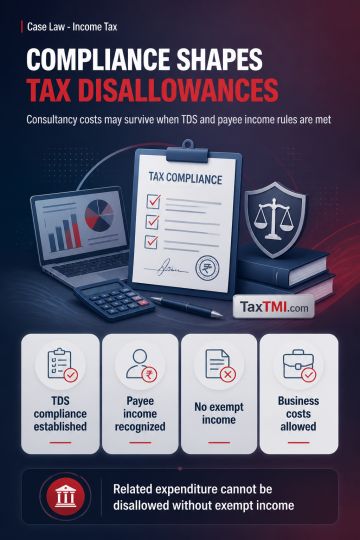
Tax deduction compliance and payee income recognition govern consultancy disallowance, while no exempt income prevents related expenditure disallowanc...
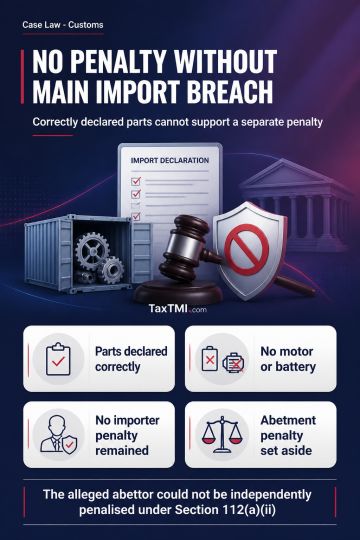
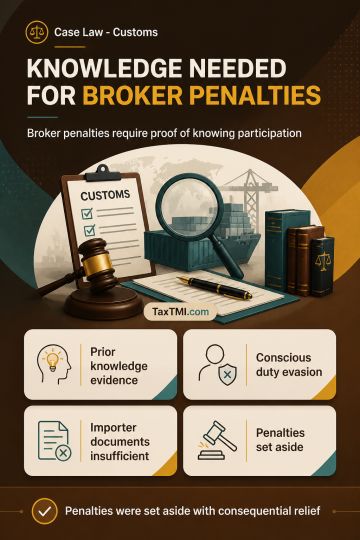
Derivative abetment liability fails when correctly declared imported components establish no underlying improper importation by the principal importer...
Page of 4805
Press 'Enter' after typing page number.
701 to 720 of 96100 Results
❮
❯
❯❯
0 / 200
Expand Note
Add to Folder
No Folders have been created
+
Are you sure you want to delete "My most important" ?
Denial of CENVAT credit for expenses incurred at unregistered branches and the demand raised by revenue authorities. The key points are: The appellant undertakes technical testing and analysis services on blood samples obtained during human trials. The final analysis report is prepared at the Ahmedabad office, although samples are collected from unregistered branches. The Tribunal held that CENVAT credit cannot be denied merely because samples are collected from unregistered branches, as the entire activity is accounted for and carried out from the registered Ahmedabad office. Centralized registration is not a prerequisite for availing CENVAT credit; the criteria is that the input service should be used for providing output service and service tax should be paid. As all activities are ultimately attributed to the Ahmedabad office, availment of CENVAT credit there is valid. The demand based on the difference between taxable income in profit and loss account and taxable value declared in ST-3 returns is unsustainable unless revenue establishes the nature of service for the difference. The appellant provided reconciliation and paid service tax on excess amount. Demands based on alleged totaling mistakes and short payment of service tax are unsustainable as the appellant provided explanations and evidence of correct payment. The demand based on debit notes issued by Wockhardt Ltd. is unsustainable.
Denial of CENVAT credit for expenses incurred at unregistered branches and the demand raised by revenue authorities. The key points are: The appellant undertakes technical testing and analysis services on blood samples obtained during human trials. The final analysis report is prepared at the Ahmedabad office, although samples are collected from unregistered branches. The Tribunal held that CENVAT credit cannot be denied merely because samples are collected from unregistered branches, as the entire activity is accounted for and carried out from the registered Ahmedabad office. Centralized registration is not a prerequisite for availing CENVAT credit; the criteria is that the input service should be used for providing output service and service tax should be paid. As all activities are ultimately attributed to the Ahmedabad office, availment of CENVAT credit there is valid. The demand based on the difference between taxable income in profit and loss account and taxable value declared in ST-3 returns is unsustainable unless revenue establishes the nature of service for the difference. The appellant provided reconciliation and paid service tax on excess amount. Demands based on alleged totaling mistakes and short payment of service tax are unsustainable as the appellant provided explanations and evidence of correct payment. The demand based on debit notes issued by Wockhardt Ltd. is unsustainable.
Note: It is a system-generated summary and is for quick reference only.
 TaxTMI
 of 4805




 Join Channel


 TaxTMI