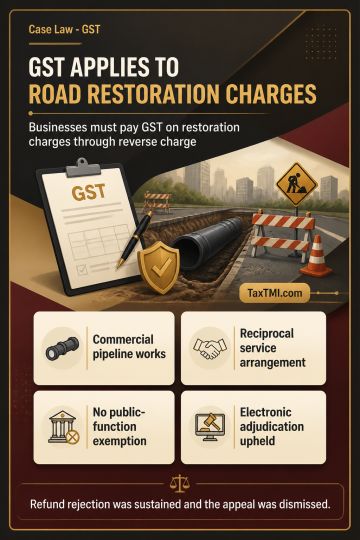
Request-driven road restoration attracts reverse-charge GST, not governmental-function treatment or compensatory-damages status for business recipient...
Road restoration charges for commercial pipeline works are taxable Government services, with reverse charge liability and no public-function exemption...
Model-wise import cap monitoring cannot justify withholding used multifunction machines where all-India tracking is absent and full security is furnis...
Claim of second sale exemption and the imposition of penalty u/s 12(5)(iii). The High Court held that when the burden was on the dealer to prove the factum of second sale, the respondent had failed to discharge this burden by proving the actual first sale, which was a prerequisite for claiming the exemption. The Tribunal had erroneously shifted the burden from the dealer to the revenue. Relying on previous decisions, the High Court reiterated that the burden of proving an earlier taxable sale was on the assessee. Regarding the penalty u/s 12(5)(iii), the Court held that since the respondent had wilfully suppressed taxable turnover and failed to file returns, the Assessing Officer was justified in imposing the penalty, and the Tribunal's decision to delete the penalty was untenable. Consequently, the High Court set aside the Tribunal's order and restored the assessment order confirmed by the appellate authority.
Claim of second sale exemption and the imposition of penalty u/s 12(5)(iii). The High Court held that when the burden was on the dealer to prove the factum of second sale, the respondent had failed to discharge this burden by proving the actual first sale, which was a prerequisite for claiming the exemption. The Tribunal had erroneously shifted the burden from the dealer to the revenue. Relying on previous decisions, the High Court reiterated that the burden of proving an earlier taxable sale was on the assessee. Regarding the penalty u/s 12(5)(iii), the Court held that since the respondent had wilfully suppressed taxable turnover and failed to file returns, the Assessing Officer was justified in imposing the penalty, and the Tribunal's decision to delete the penalty was untenable. Consequently, the High Court set aside the Tribunal's order and restored the assessment order confirmed by the appellate authority.
Note: It is a system-generated summary and is for quick reference only.
 TaxTMI
  TaxTMI
 of 4918