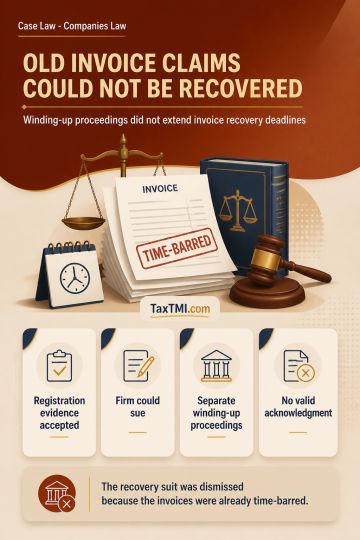
Invoice-based recovery claims remain time-barred despite separate winding-up proceedings, absent valid acknowledgment or part-payment of the disputed ...
Extended limitation fails without specific suppression allegations, while overseas employee secondment remains taxable as manpower supply within norma...
Time-share accommodation classification excludes Club or Association Service where purchasers receive contractual occupancy rights without genuine mem...
CENVAT credit for trading requires reversal, while taxable-service rental credit remains proportionately available and limitation issues await resolut...
Page of 4792
Press 'Enter' after typing page number.
61 to 80 of 95833 Results
❮
❯
❯❯
0 / 200
Expand Note
Add to Folder
No Folders have been created
+
Are you sure you want to delete "My most important" ?
The High Court dismissed the writ petition challenging the notice issued u/s 65 of the Maharashtra Goods and Services Tax Act, 2017 for conducting an audit for the financial year 2020-21, even though the petitioner had ceased to be registered on the date of ordering the audit. The Court held that the provisions of Section 65 dealing with audit would apply to a person who was registered under the CGST Act for the period for which an audit is ordered, irrespective of subsequent de-registration. The preliminary audit report had found excess input tax credit claimed, improper reversal of input tax credit, and short disclosure of other income, resulting in a total tax plus interest liability. The Court observed that a person cannot escape audit proceedings by claiming de-registration, as obligations u/s 65(5) must be complied with, and Section 29(3) requires discharge of obligations even after cancellation of registration. Obstructing audit proceedings by taking such a plea would be improper if the assessee has defaulted in tax payment, wrongly availed input tax credit or refund.
The High Court dismissed the writ petition challenging the notice issued u/s 65 of the Maharashtra Goods and Services Tax Act, 2017 for conducting an audit for the financial year 2020-21, even though the petitioner had ceased to be registered on the date of ordering the audit. The Court held that the provisions of Section 65 dealing with audit would apply to a person who was registered under the CGST Act for the period for which an audit is ordered, irrespective of subsequent de-registration. The preliminary audit report had found excess input tax credit claimed, improper reversal of input tax credit, and short disclosure of other income, resulting in a total tax plus interest liability. The Court observed that a person cannot escape audit proceedings by claiming de-registration, as obligations u/s 65(5) must be complied with, and Section 29(3) requires discharge of obligations even after cancellation of registration. Obstructing audit proceedings by taking such a plea would be improper if the assessee has defaulted in tax payment, wrongly availed input tax credit or refund.
Note: It is a system-generated summary and is for quick reference only.
 TaxTMI
 of 4792


















 Join Channel


 TaxTMI

