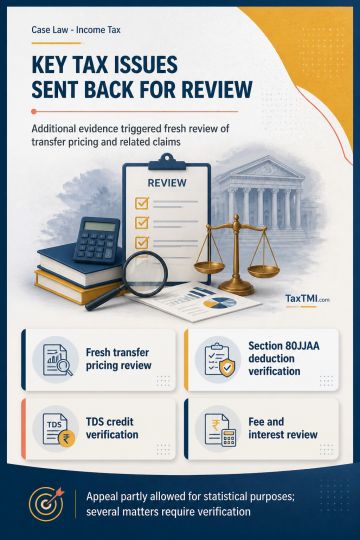
Additional evidence in transfer pricing dispute leads to fresh examination, while tax deductions, TDS credit, fee and refund interest require verifica...
Category II AIF pass-through taxation preserves non-business income character; investment receipts cannot be reclassified without applying recognised ...
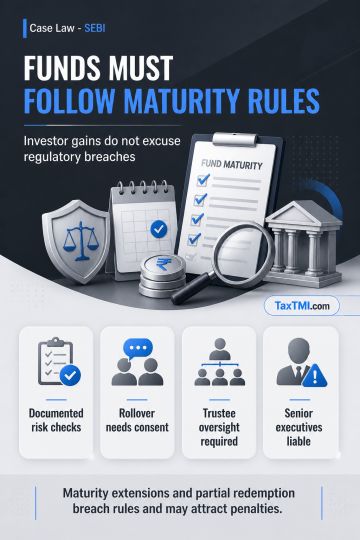
Mutual fund maturity rules require proper rollover, redemption, disclosure, and due diligence; investor gains cannot excuse regulatory breaches or pen...
Threshold exemption excludes exempt services, while stamp-paper purchases avoid reverse charge; consequential service tax penalties were also set asid...
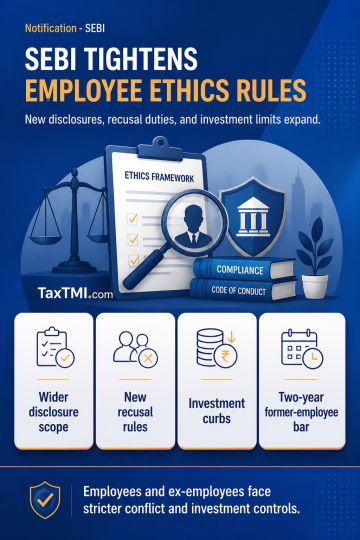
Employee conflict disclosures and investment restrictions expand with new recusal duties, post-employment limits, and compliance reporting requirement...
The case pertains to the jurisdiction of impugned orders under the U.P.G.S.T. Act, 2017, and the time limitation u/s 73 and Section 44 of the Act. The key points are: the retrospective effect of notifications, the time limit prescribed for issuing orders u/s 73(9) based on the due date of filing annual returns u/s 44(1), and the validity of the impugned orders in light of this time limit. The due date for filing the annual return for the financial year 2017-18 was extended to 05.02.2020 via notifications. Consequently, the three-year time limit u/s 73(10) for issuing orders ended on 05.02.2023. However, the impugned orders were dated 05.10.2024 and 02.12.2023, beyond the prescribed time limit. Therefore, the High Court held that the impugned orders were beyond jurisdiction, being barred by the time limit u/s 73(10). Consequently, the writ petition was allowed, the impugned orders were quashed, and the petitioner's frozen accounts were ordered to be de-frozen.
The case pertains to the jurisdiction of impugned orders under the U.P.G.S.T. Act, 2017, and the time limitation u/s 73 and Section 44 of the Act. The key points are: the retrospective effect of notifications, the time limit prescribed for issuing orders u/s 73(9) based on the due date of filing annual returns u/s 44(1), and the validity of the impugned orders in light of this time limit. The due date for filing the annual return for the financial year 2017-18 was extended to 05.02.2020 via notifications. Consequently, the three-year time limit u/s 73(10) for issuing orders ended on 05.02.2023. However, the impugned orders were dated 05.10.2024 and 02.12.2023, beyond the prescribed time limit. Therefore, the High Court held that the impugned orders were beyond jurisdiction, being barred by the time limit u/s 73(10). Consequently, the writ petition was allowed, the impugned orders were quashed, and the petitioner's frozen accounts were ordered to be de-frozen.
Note: It is a system-generated summary and is for quick reference only.
 TaxTMI
 of 4803












 Join Channel


 TaxTMI
