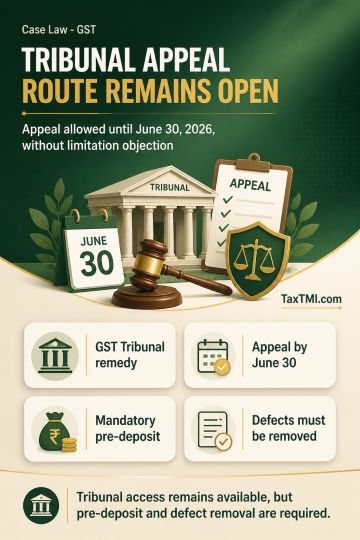
Transfer pricing and tax deductions upheld on established principles, while employee contributions and warranty provisions returned for fresh examinat...
Captive transfer pricing relies on industrial consumer tariffs, while genuine quotations can benchmark effluent treatment transfers under the Other Me...
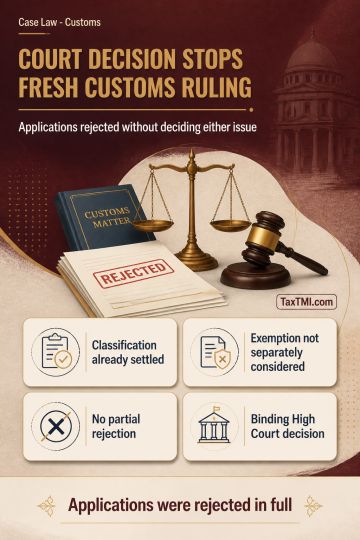
Specific tariff classification for ophthalmic instruments and extended limitation principles determine the treatment of duty demands, confiscation, an...
Integrated golf function determines classification, placing launch monitors and simulators under other golf equipment rather than measuring instrument...
Public servant status under anti-corruption law extends to recognised stock exchange leadership; constitutional and sanction challenges do not succeed...
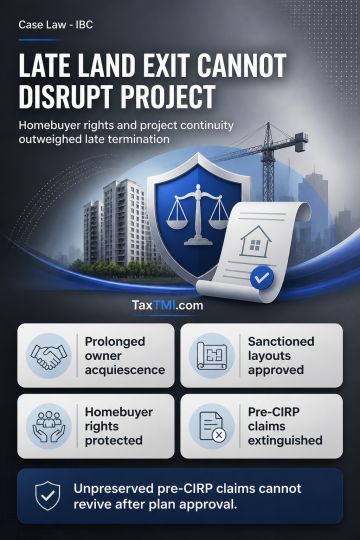
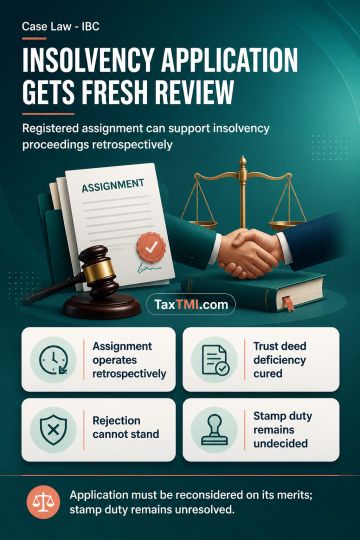
Acquiescence, homebuyer protection and clean-slate resolution principles prevent landowners from disrupting an integrated project through late termina...
The case pertains to the jurisdiction of impugned orders under the U.P.G.S.T. Act, 2017, and the time limitation u/s 73 and Section 44 of the Act. The key points are: the retrospective effect of notifications, the time limit prescribed for issuing orders u/s 73(9) based on the due date of filing annual returns u/s 44(1), and the validity of the impugned orders in light of this time limit. The due date for filing the annual return for the financial year 2017-18 was extended to 05.02.2020 via notifications. Consequently, the three-year time limit u/s 73(10) for issuing orders ended on 05.02.2023. However, the impugned orders were dated 05.10.2024 and 02.12.2023, beyond the prescribed time limit. Therefore, the High Court held that the impugned orders were beyond jurisdiction, being barred by the time limit u/s 73(10). Consequently, the writ petition was allowed, the impugned orders were quashed, and the petitioner's frozen accounts were ordered to be de-frozen.
The case pertains to the jurisdiction of impugned orders under the U.P.G.S.T. Act, 2017, and the time limitation u/s 73 and Section 44 of the Act. The key points are: the retrospective effect of notifications, the time limit prescribed for issuing orders u/s 73(9) based on the due date of filing annual returns u/s 44(1), and the validity of the impugned orders in light of this time limit. The due date for filing the annual return for the financial year 2017-18 was extended to 05.02.2020 via notifications. Consequently, the three-year time limit u/s 73(10) for issuing orders ended on 05.02.2023. However, the impugned orders were dated 05.10.2024 and 02.12.2023, beyond the prescribed time limit. Therefore, the High Court held that the impugned orders were beyond jurisdiction, being barred by the time limit u/s 73(10). Consequently, the writ petition was allowed, the impugned orders were quashed, and the petitioner's frozen accounts were ordered to be de-frozen.
Note: It is a system-generated summary and is for quick reference only.
 TaxTMI
 of 4803















 Join Channel


 TaxTMI