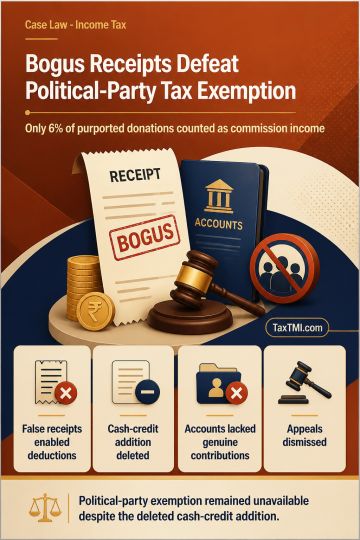
Bogus donation receipts justified commission income assessment and defeated political-party tax exemption for inaccurate accounts and reporting failur...
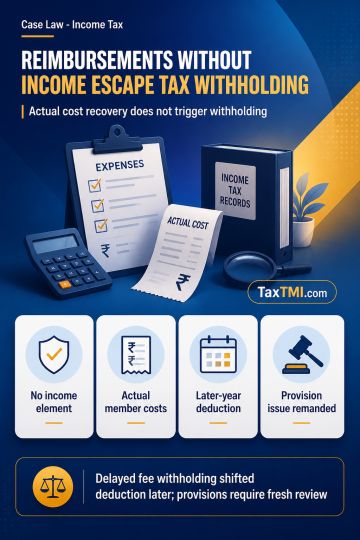
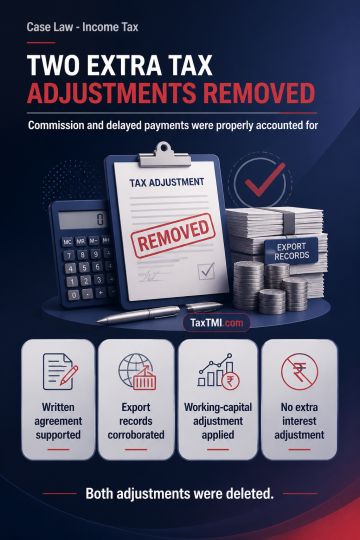
Pure reimbursement without income element escapes tax withholding, while delayed withholding and unsupported provisions face deferred or renewed scrut...
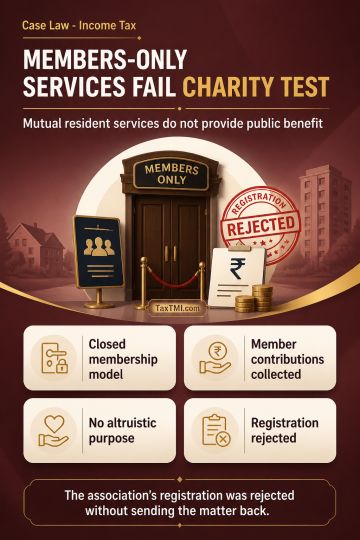
Public benefit requirement defeats charitable registration where residents' association services are reciprocal, member-only facilities governed by mu...
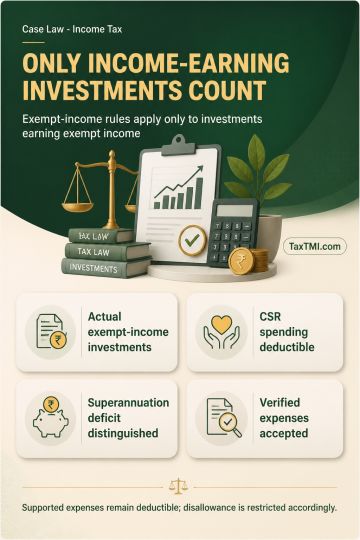
Exempt-income expenditure disallowance is confined to investments that actually generated exempt income, while supported business expenses remain dedu...
Objective characteristics and principal use govern mining-tyre classification, while fresh advance ruling applications may rely on additional technica...
Page of 4788
Press 'Enter' after typing page number.
461 to 480 of 95752 Results
❮
❯
❯❯
0 / 200
Expand Note
Add to Folder
No Folders have been created
+
Are you sure you want to delete "My most important" ?
Seizure of goods as smuggled into the country from Myanmar u/s 130 of the Customs Act, 1962. The burden of proof lies on the respondent u/s 123 to show that the seized areca nuts are not smuggled goods, or on the Department u/s 111 to establish that the seized betel nuts are of foreign origin and smuggled before confiscation. The High Court emphasized that the existence of a substantial question of law is a prerequisite for exercising jurisdiction u/s 130. The Court examined whether the Appellate Tribunal ignored material evidence or acted without evidence, which could constitute a substantial question of law. The Court analyzed the evidence, including the proximity to the international border, lack of foreign markings, absence of expert opinion on origin, and documents showing purchase from a local store. The Court concluded that the Tribunal's order cannot be treated as perverse, as it was not arrived at without evidence or reasons, thus answering the substantial question of law framed regarding perversity against the appellant.
Seizure of goods as smuggled into the country from Myanmar u/s 130 of the Customs Act, 1962. The burden of proof lies on the respondent u/s 123 to show that the seized areca nuts are not smuggled goods, or on the Department u/s 111 to establish that the seized betel nuts are of foreign origin and smuggled before confiscation. The High Court emphasized that the existence of a substantial question of law is a prerequisite for exercising jurisdiction u/s 130. The Court examined whether the Appellate Tribunal ignored material evidence or acted without evidence, which could constitute a substantial question of law. The Court analyzed the evidence, including the proximity to the international border, lack of foreign markings, absence of expert opinion on origin, and documents showing purchase from a local store. The Court concluded that the Tribunal's order cannot be treated as perverse, as it was not arrived at without evidence or reasons, thus answering the substantial question of law framed regarding perversity against the appellant.
Note: It is a system-generated summary and is for quick reference only.
 TaxTMI
 of 4788







 Join Channel


 TaxTMI