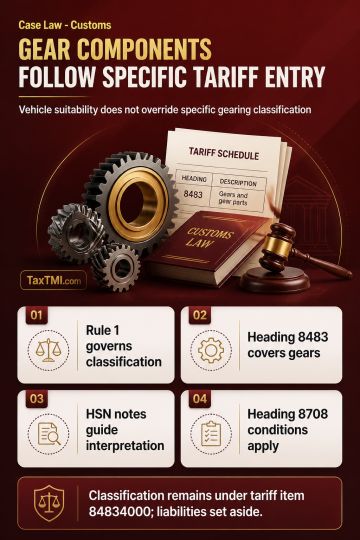
Tariff classification of vehicle gear components follows the specific gearing entry, displacing motor-vehicle parts classification and related liabili...
Necessary-party requirements limit impleadment of independent entities, while deferred consideration does not create an appealable adverse determinati...
Food supplement classification requires common parlance and authoritative tests, preventing treatment as proprietary Ayurvedic medicines without suppo...
Specified regulatory authority income receives conditional tax exemption, subject to non-commercial activity, unchanged income character, and return f...
Tax exemption for regulatory authority income applies retrospectively, subject to non-commercial activity, unchanged income sources, and return-filing...
This circular clarifies the classification of clear float glass under the Customs Tariff Act, 1975. It addresses whether the presence of a tin layer on one side of float glass should be treated as an absorbent, reflective layer, impacting its classification. The circular refers to Chapter Note 2(c) of Chapter 70, defining "absorbent, reflecting or non-reflecting layer" as a microscopically thin coating of metal or chemical compound that absorbs infrared light, improves reflecting qualities, or prevents light reflection while retaining transparency/translucency. After consulting CSIR-Central Glass & Ceramic Research Institute, it concludes that the tin layer on float glass is inherent to the manufacturing process and does not satisfy the definition under Note 2(c). Consequently, clear float glass without wiring, coloring, reflective or tinted properties, and only a tin layer on one side without any other metal oxide layer, will be classified under tariff item 7005 29 90 as it lacks an absorbent layer.
This circular clarifies the classification of clear float glass under the Customs Tariff Act, 1975. It addresses whether the presence of a tin layer on one side of float glass should be treated as an absorbent, reflective layer, impacting its classification. The circular refers to Chapter Note 2(c) of Chapter 70, defining "absorbent, reflecting or non-reflecting layer" as a microscopically thin coating of metal or chemical compound that absorbs infrared light, improves reflecting qualities, or prevents light reflection while retaining transparency/translucency. After consulting CSIR-Central Glass & Ceramic Research Institute, it concludes that the tin layer on float glass is inherent to the manufacturing process and does not satisfy the definition under Note 2(c). Consequently, clear float glass without wiring, coloring, reflective or tinted properties, and only a tin layer on one side without any other metal oxide layer, will be classified under tariff item 7005 29 90 as it lacks an absorbent layer.
Note: It is a system-generated summary and is for quick reference only.
 TaxTMI
 of 4782



















 Join Channel


 TaxTMI
