Political contribution deductions require recipient party compliance with contribution-reporting conditions; banking-channel donations alone do not qu...
Aggregation under TNMM prevents selective testing of intra-group services without comparable uncontrolled transactions, while appellate additional cla...
Protective assessment cannot duplicate identical receipts under competing characterisations; remote services did not establish a taxable permanent est...
Current account treatment of overseas tournament services removed most FEMA findings, but excess EEFC remittance and delayed repatriation remained bre...
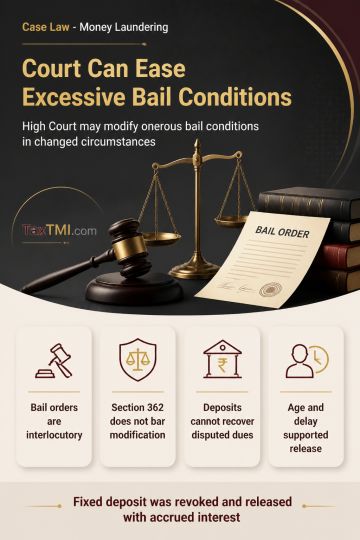
Modification of bail conditions remains available through inherent jurisdiction where onerous deposits undermine justice and cannot recover disputed d...
Merchant banker regulation consolidates registration, governance, capital, reporting, outsourcing and investor-protection requirements under an update...
This circular clarifies the classification of clear float glass under the Customs Tariff Act, 1975. It addresses whether the presence of a tin layer on one side of float glass should be treated as an absorbent, reflective layer, impacting its classification. The circular refers to Chapter Note 2(c) of Chapter 70, defining "absorbent, reflecting or non-reflecting layer" as a microscopically thin coating of metal or chemical compound that absorbs infrared light, improves reflecting qualities, or prevents light reflection while retaining transparency/translucency. After consulting CSIR-Central Glass & Ceramic Research Institute, it concludes that the tin layer on float glass is inherent to the manufacturing process and does not satisfy the definition under Note 2(c). Consequently, clear float glass without wiring, coloring, reflective or tinted properties, and only a tin layer on one side without any other metal oxide layer, will be classified under tariff item 7005 29 90 as it lacks an absorbent layer.
This circular clarifies the classification of clear float glass under the Customs Tariff Act, 1975. It addresses whether the presence of a tin layer on one side of float glass should be treated as an absorbent, reflective layer, impacting its classification. The circular refers to Chapter Note 2(c) of Chapter 70, defining "absorbent, reflecting or non-reflecting layer" as a microscopically thin coating of metal or chemical compound that absorbs infrared light, improves reflecting qualities, or prevents light reflection while retaining transparency/translucency. After consulting CSIR-Central Glass & Ceramic Research Institute, it concludes that the tin layer on float glass is inherent to the manufacturing process and does not satisfy the definition under Note 2(c). Consequently, clear float glass without wiring, coloring, reflective or tinted properties, and only a tin layer on one side without any other metal oxide layer, will be classified under tariff item 7005 29 90 as it lacks an absorbent layer.
Note: It is a system-generated summary and is for quick reference only.
 TaxTMI
 of 4782


















 Join Channel


 TaxTMI