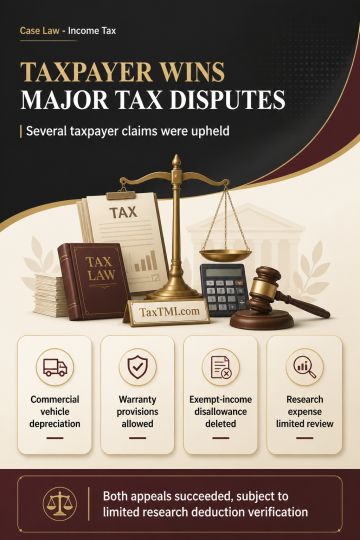
Commercial vehicle depreciation, scientifically determined warranty provisions and exempt-income disallowances were resolved in favour of the taxpayer...
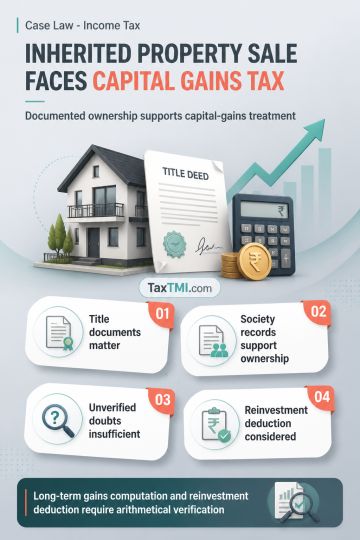
Inherited property sale proceeds require capital-gains treatment where ownership is supported by evidence, not suspicion or unverified signature doubt...
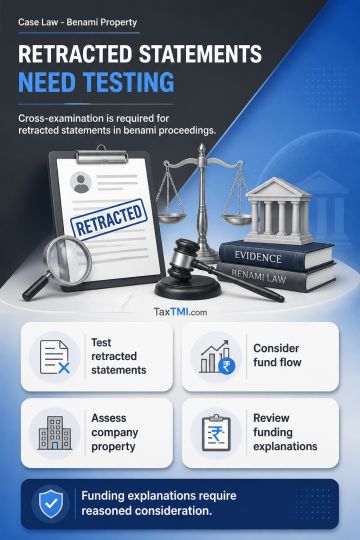
Cross-examination of retracted statements is essential where foundational evidence supports a benami allegation and documented funding explanations re...
Capital-goods exemption covers plant-modernisation accessories, while the import restriction applies only to earlier capital-goods components and spar...
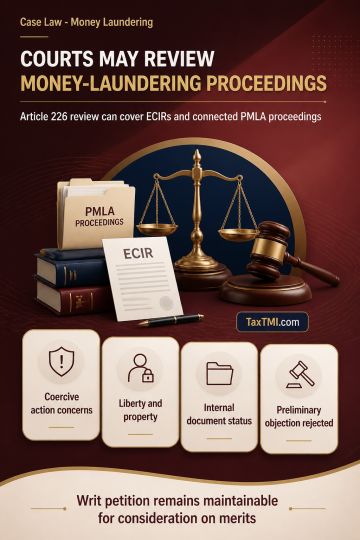
Constitutional judicial review permits challenges to ECIRs and connected money-laundering proceedings where coercive action affects fundamental intere...
The Appellate Tribunal examined the reopening of assessment after four years and the addition u/s 68 of the Income Tax Act. It held that the original assessment was completed on 27.11.2018, and the notice u/s 148 for reopening was issued on 22.03.2019, after the expiry of the four-year period from the end of the assessment year 2011-12. The assessee had disclosed the information regarding the receipt of share capital in the return and financial statements during the original assessment. The Assessing Officer failed to substantiate any fault on the assessee's part in fully and truly disclosing material facts. Relying on the Bombay High Court's decisions in Everest Kanto Cylinder Ltd. and Ananta Landmark (P) Ltd., the Tribunal held that after four years, reassessment is not permissible unless the assessee failed to truly and fully disclose necessary facts. Since the assessee had disclosed the details of shareholders who subscribed to the share capital, and the Assessing Officer had already made an addition for one shareholder in the original reopening order, the reopening beyond four years without recording any lapses on the assessee's part for non-disclosure was invalid. The assessee's appeal was allowed.
The Appellate Tribunal examined the reopening of assessment after four years and the addition u/s 68 of the Income Tax Act. It held that the original assessment was completed on 27.11.2018, and the notice u/s 148 for reopening was issued on 22.03.2019, after the expiry of the four-year period from the end of the assessment year 2011-12. The assessee had disclosed the information regarding the receipt of share capital in the return and financial statements during the original assessment. The Assessing Officer failed to substantiate any fault on the assessee's part in fully and truly disclosing material facts. Relying on the Bombay High Court's decisions in Everest Kanto Cylinder Ltd. and Ananta Landmark (P) Ltd., the Tribunal held that after four years, reassessment is not permissible unless the assessee failed to truly and fully disclose necessary facts. Since the assessee had disclosed the details of shareholders who subscribed to the share capital, and the Assessing Officer had already made an addition for one shareholder in the original reopening order, the reopening beyond four years without recording any lapses on the assessee's part for non-disclosure was invalid. The assessee's appeal was allowed.
Note: It is a system-generated summary and is for quick reference only.
 TaxTMI
 of 4782









 Join Channel


 TaxTMI
