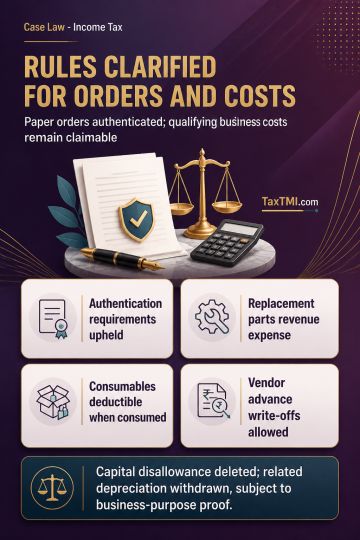
Authentication of paper assessment orders upheld, while qualifying repairs, consumables and vendor advance write-offs remain deductible business claim...
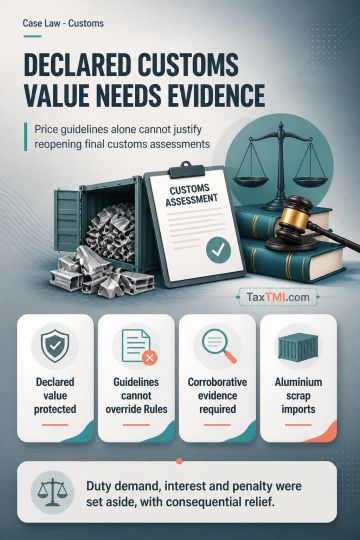
Transaction value cannot be rejected solely on non-statutory valuation guidelines without corroborative evidence supporting reassessment of final cust...
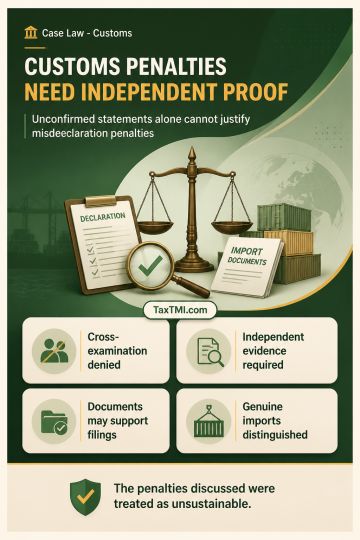
Cross-examination rights and corroborated evidence limit customs penalties for misdeclaration in genuine import transactions involving documented clea...
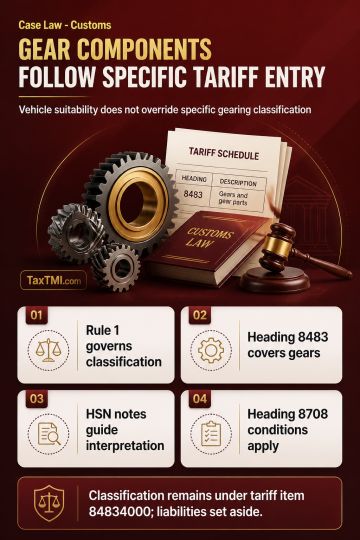
Tariff classification of vehicle gear components follows the specific gearing entry, displacing motor-vehicle parts classification and related liabili...
Page of 4786
Press 'Enter' after typing page number.
381 to 400 of 95715 Results
❮
❯
❯❯
0 / 200
Expand Note
Add to Folder
No Folders have been created
+
Are you sure you want to delete "My most important" ?
In this case, the Income Tax Appellate Tribunal (ITAT) examined the additions made by the Assessing Officer (AO) regarding long-term capital gains (LTCG) from share transactions treated as sham, additions u/ss 68 or 69A for unexplained credits, and addition u/s 69C for alleged unaccounted commission paid. The key points are: The claim for exemption on LTCG cannot be denied merely on suspicion or surmises regarding penny stocks, disregarding direct evidence like contract notes, banking channels, STT payment, and demat account. The AO must provide cogent corroborative material to establish unaccounted income routed back. Mere share value appreciation cannot justify treating transactions as fictitious. The shares were acquired through preferential allotment directly from the company, not brokers. Payment was through banking channels, delivery taken in demat account, held for over a year, contract notes issued, and sold on recognized stock exchange. SEBI did not declare the investee company bogus. Additions u/s 68 apply to credits in books of account, not bank statements. Section 69A addition was made solely on the presumption of redeploying undisclosed income as capital gains without independent tangible evidence of undisclosed income or bogus transactions. The 6.5% addition.
In this case, the Income Tax Appellate Tribunal (ITAT) examined the additions made by the Assessing Officer (AO) regarding long-term capital gains (LTCG) from share transactions treated as sham, additions u/ss 68 or 69A for unexplained credits, and addition u/s 69C for alleged unaccounted commission paid. The key points are: The claim for exemption on LTCG cannot be denied merely on suspicion or surmises regarding penny stocks, disregarding direct evidence like contract notes, banking channels, STT payment, and demat account. The AO must provide cogent corroborative material to establish unaccounted income routed back. Mere share value appreciation cannot justify treating transactions as fictitious. The shares were acquired through preferential allotment directly from the company, not brokers. Payment was through banking channels, delivery taken in demat account, held for over a year, contract notes issued, and sold on recognized stock exchange. SEBI did not declare the investee company bogus. Additions u/s 68 apply to credits in books of account, not bank statements. Section 69A addition was made solely on the presumption of redeploying undisclosed income as capital gains without independent tangible evidence of undisclosed income or bogus transactions. The 6.5% addition.
Note: It is a system-generated summary and is for quick reference only.
 TaxTMI
 of 4786




 Join Channel


 TaxTMI