Cooperative society deposits, member-interest TDS exemption and credit-facility deduction claims require verification through records and supporting e...
Customs jurisdiction over EPCG condition breaches survives export-obligation discharge certificates, requiring alleged fraud and misdeclaration to be ...
Contractual tolerance requires consideration; breach recoveries, qualifying public infrastructure services and road works escape service tax liability...
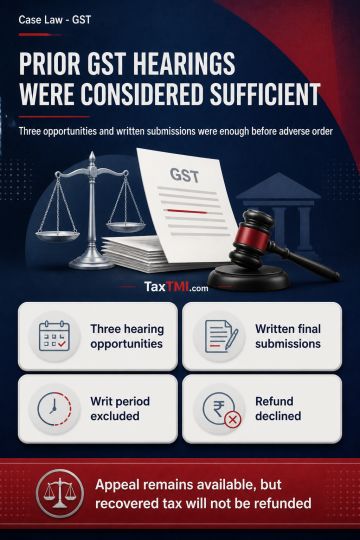
Personal hearing requirements in GST adjudication were satisfied by prior opportunities and written submissions; appellate limitation received writ-pe...
Page of 4790
Press 'Enter' after typing page number.
581 to 600 of 95794 Results
❮
❯
❯❯
0 / 200
Expand Note
Add to Folder
No Folders have been created
+
Are you sure you want to delete "My most important" ?
The appellant manufactured 'Gold Dore Bars' having purity less than 95% from gold ore/concentrate and claimed exemption under Notification No. 12/2012-CE as 'Gold Bars'. The Tribunal held that 'Gold Dore Bars' with less than 95% purity cannot be equated with 'Gold Bars' as per the Notification's Explanation defining 'Gold Dore Bars' as raw material for manufacturing 'Gold Bars'. The appellant's argument of common parlance understanding was rejected, as the Notification treated them as distinct products. While upholding the demand for differential duty for the normal period, the extended period and penalty were set aside, as there was no suppression of facts, only an interpretation issue. The matter was remanded for determining differential duty and interest for the normal period.
The appellant manufactured 'Gold Dore Bars' having purity less than 95% from gold ore/concentrate and claimed exemption under Notification No. 12/2012-CE as 'Gold Bars'. The Tribunal held that 'Gold Dore Bars' with less than 95% purity cannot be equated with 'Gold Bars' as per the Notification's Explanation defining 'Gold Dore Bars' as raw material for manufacturing 'Gold Bars'. The appellant's argument of common parlance understanding was rejected, as the Notification treated them as distinct products. While upholding the demand for differential duty for the normal period, the extended period and penalty were set aside, as there was no suppression of facts, only an interpretation issue. The matter was remanded for determining differential duty and interest for the normal period.
Note: It is a system-generated summary and is for quick reference only.
 TaxTMI
 of 4790




















 Join Channel


 TaxTMI