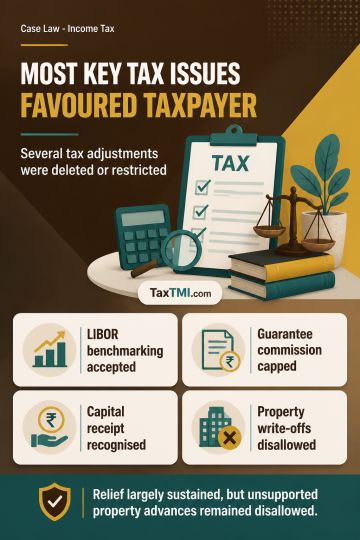
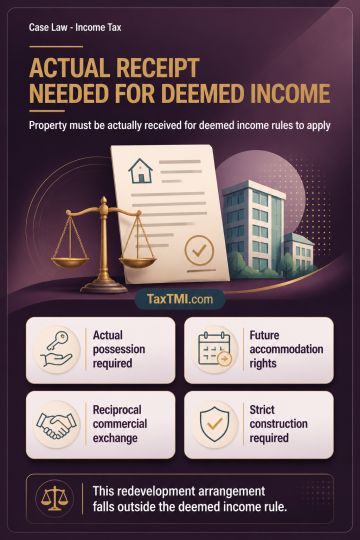
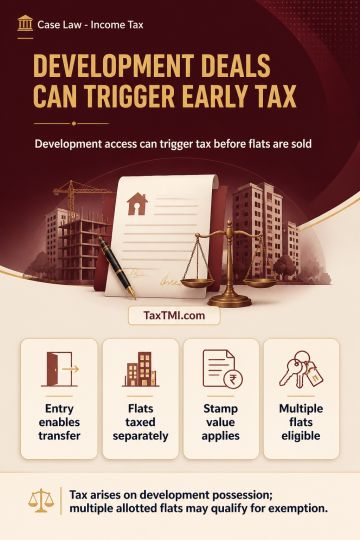
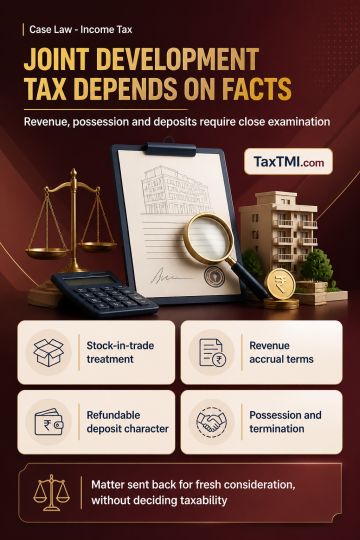
Receipt of immovable property requires actual possession or enjoyment; redevelopment allotments exchanged for tenancy rights fall outside deemed incom...
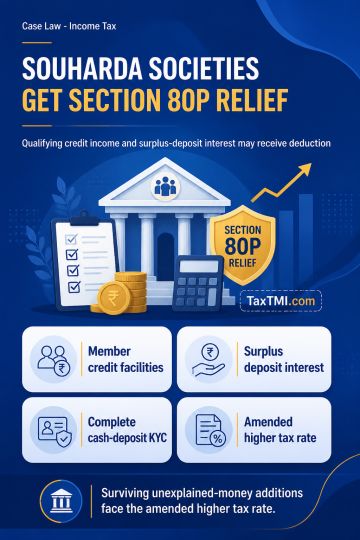
Section 80P deduction covers Souharda credit societies, including qualifying surplus-deposit interest, subject to member KYC verification for cash dep...
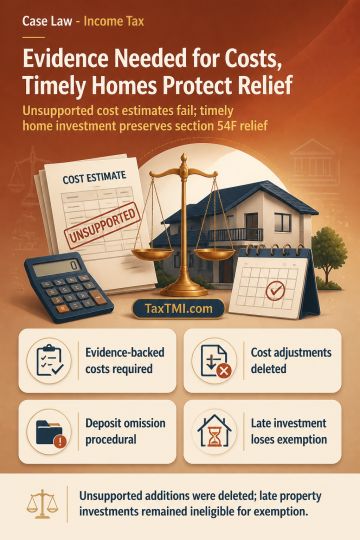
Transfer-pricing benchmarking and capital-receipt principles sustained taxpayer relief, while unsupported property-advance write-offs remained disallo...
Page of 4801
Press 'Enter' after typing page number.
941 to 960 of 96001 Results
❮
❯
❯❯
0 / 200
Expand Note
Add to Folder
No Folders have been created
+
Are you sure you want to delete "My most important" ?
The assessee provided documentary evidence supporting the purchase and subsequent sale of shares leading to long-term capital gains (LTCG). The evidence included purchase bills, bank statements showing payment, demat account reflecting share holdings, online sale through a recognized broker with contract notes, and receipt of sale proceeds in the bank account. The Assessing Officer (AO) treated the LTCG as bogus based on statements from third parties involved in providing accommodation entries, denying exemption u/s 10(38). However, the AO failed to produce any incriminating material or evidence contradicting the assessee's documents. Mere uncorroborated statements from third parties cannot render a transaction bogus without cogent contrary evidence. Following judicial precedents, the Income Tax Appellate Tribunal (ITAT) held that the claim for LTCG exemption u/s 10(38) is valid, and the addition made by the AO was deleted. Consequently, the addition u/s 69C for alleged notional commission paid was also rejected.
The assessee provided documentary evidence supporting the purchase and subsequent sale of shares leading to long-term capital gains (LTCG). The evidence included purchase bills, bank statements showing payment, demat account reflecting share holdings, online sale through a recognized broker with contract notes, and receipt of sale proceeds in the bank account. The Assessing Officer (AO) treated the LTCG as bogus based on statements from third parties involved in providing accommodation entries, denying exemption u/s 10(38). However, the AO failed to produce any incriminating material or evidence contradicting the assessee's documents. Mere uncorroborated statements from third parties cannot render a transaction bogus without cogent contrary evidence. Following judicial precedents, the Income Tax Appellate Tribunal (ITAT) held that the claim for LTCG exemption u/s 10(38) is valid, and the addition made by the AO was deleted. Consequently, the addition u/s 69C for alleged notional commission paid was also rejected.
Note: It is a system-generated summary and is for quick reference only.
 TaxTMI
 of 4801



 Join Channel


 TaxTMI