Retention of seized property survives where recorded reasons support proceeds of crime, while stayed investigation periods are excluded from limitatio...
Specified income of Baddi Barotiwala Nalagarh Development Authority receives conditional tax exemption, retrospectively covering its designated assess...
Specified development authority income receives retrospective tax exemption, subject to non-commercial activity, unchanged income sources, and return-...
Unified Brand India framework introduces voluntary Trust Mark certification and funding support for export branding, packaging and global promotional ...
Origin Declaration authentication governs preferential tariff claims under India-UK CETA, requiring a validated reference number before import clearan...
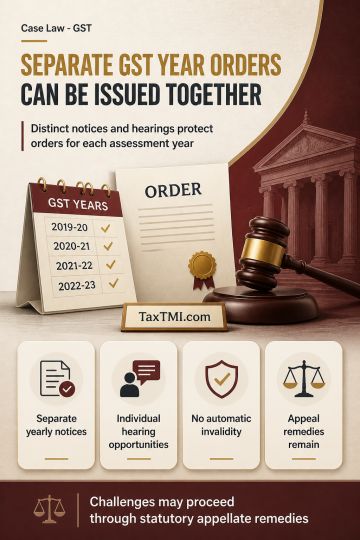
Separate assessment orders for different years remain valid when distinct notices and hearing opportunities prevent prejudice from combined proceeding...
The appellant imported goods known as Tetramethyldodehdronaphto Furan (TF), classified as Aroma Chemicals. The show cause notice sought change in classification on grounds of its use as raw material for manufacturing synthetic perfumery compounds, fragrances, and flavour formulas. The Tribunal held that classification must be determined based on description in tariff headings, chapter and section notes, and rules of interpretation. The imported product, being a mixture of two isomers, is classifiable under Chapter 29 as per Chapter Note 1(b). The order relied on Chapter Note 1(e) to assert that when a product is dissolved in solvents making it suitable only for specific use, it can be taken out of Chapter 29. However, no evidence was produced regarding presence of solvents or suitability for single use. Consequently, the impugned order was set aside, and the appeal was allowed.
The appellant imported goods known as Tetramethyldodehdronaphto Furan (TF), classified as Aroma Chemicals. The show cause notice sought change in classification on grounds of its use as raw material for manufacturing synthetic perfumery compounds, fragrances, and flavour formulas. The Tribunal held that classification must be determined based on description in tariff headings, chapter and section notes, and rules of interpretation. The imported product, being a mixture of two isomers, is classifiable under Chapter 29 as per Chapter Note 1(b). The order relied on Chapter Note 1(e) to assert that when a product is dissolved in solvents making it suitable only for specific use, it can be taken out of Chapter 29. However, no evidence was produced regarding presence of solvents or suitability for single use. Consequently, the impugned order was set aside, and the appeal was allowed.
Note: It is a system-generated summary and is for quick reference only.
 TaxTMI
 of 4805

















 Join Channel


 TaxTMI
