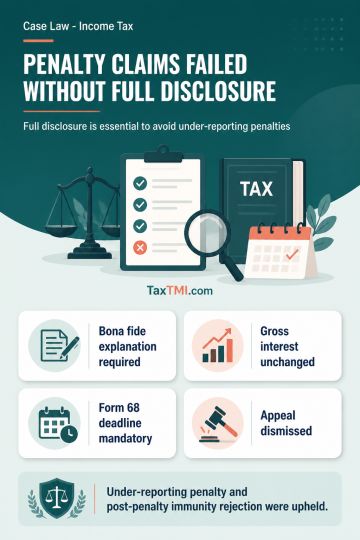
Bona fide disclosure requirements govern under-reporting penalties, and post-penalty immunity applications cannot secure available statutory protectio...
Certificate-of-origin verification procedure governs preferential customs benefits; denial without retroactive verification was set aside with consequ...
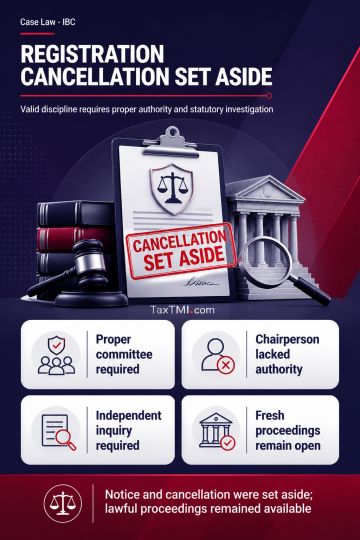
Disciplinary Committee jurisdiction and mandatory investigation requirements invalidated cancellation of an insolvency professional's registration and...
Retention of seized property survives where recorded reasons support proceeds of crime, while stayed investigation periods are excluded from limitatio...
Specified income of Baddi Barotiwala Nalagarh Development Authority receives conditional tax exemption, retrospectively covering its designated assess...
Page of 4805
Press 'Enter' after typing page number.
1221 to 1240 of 96092 Results
❮
❯
❯❯
0 / 200
Expand Note
Add to Folder
No Folders have been created
+
Are you sure you want to delete "My most important" ?
Disallowance of CENVAT credit claimed by the appellant on various inputs and input services. The key points are: The credit was denied as the inputs and services did not qualify u/rs 2(k) and 2(l) of the CENVAT Credit Rules, 2004, due to the exclusion clauses. The decisions cited by the appellant were not relevant. The Bombay High Court and Supreme Court affirmed that goods/services excluded under the definition cannot be covered by referring to the main clause. Regarding construction materials, they fall under the exclusion clause for goods used for building construction. The appellant failed to prove the activities were for renovation/repair of an existing factory, as required for the inclusion clause. The credit on security and manpower services after production commenced was allowed, as it could not be attributed to factory setup. The demand needs re-determination, and the penalty u/r 15(1) was set aside, with the appeal partly allowed.
Disallowance of CENVAT credit claimed by the appellant on various inputs and input services. The key points are: The credit was denied as the inputs and services did not qualify u/rs 2(k) and 2(l) of the CENVAT Credit Rules, 2004, due to the exclusion clauses. The decisions cited by the appellant were not relevant. The Bombay High Court and Supreme Court affirmed that goods/services excluded under the definition cannot be covered by referring to the main clause. Regarding construction materials, they fall under the exclusion clause for goods used for building construction. The appellant failed to prove the activities were for renovation/repair of an existing factory, as required for the inclusion clause. The credit on security and manpower services after production commenced was allowed, as it could not be attributed to factory setup. The demand needs re-determination, and the penalty u/r 15(1) was set aside, with the appeal partly allowed.
Note: It is a system-generated summary and is for quick reference only.
 TaxTMI
 of 4805















 Join Channel


 TaxTMI

