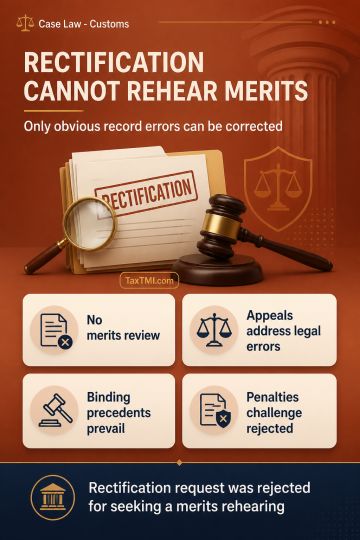
Rectification of mistake remains limited to self-evident record errors, preventing merits review through miscellaneous applications and preserving fin...
Tender creditworthiness conditions may extend to de facto Promoter Directors, with post-participation challenges generally barred absent arbitrariness...
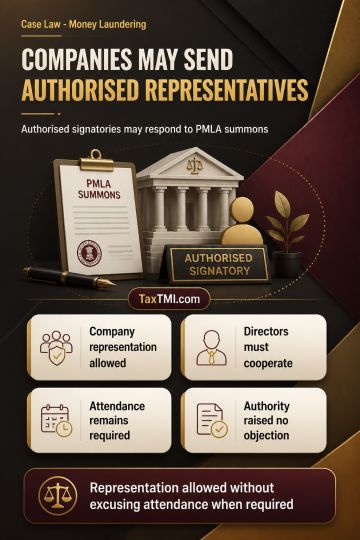
Corporate representation in PMLA summons proceedings permitted through an authorised signatory, subject to directors' continuing cooperation and atten...
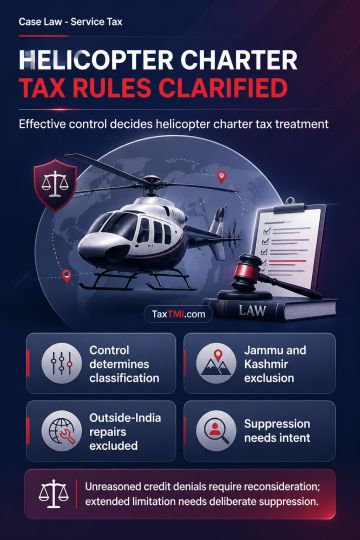
Helicopter charter classification requires effective control analysis, while territorial performance, reasoned credit orders and wilful suppression de...
Specified fund definition expands PAN exemption eligibility for registered alternative investment funds and qualifying International Financial Service...
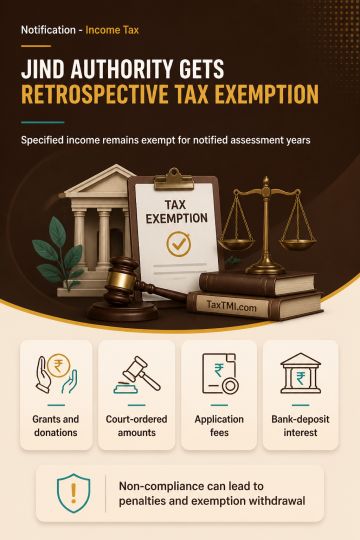
Tax exemption for specified legal-services authority income applies retrospectively, subject to non-commercial activity, unchanged income sources, and...
Disallowance of CENVAT credit claimed by the appellant on various inputs and input services. The key points are: The credit was denied as the inputs and services did not qualify u/rs 2(k) and 2(l) of the CENVAT Credit Rules, 2004, due to the exclusion clauses. The decisions cited by the appellant were not relevant. The Bombay High Court and Supreme Court affirmed that goods/services excluded under the definition cannot be covered by referring to the main clause. Regarding construction materials, they fall under the exclusion clause for goods used for building construction. The appellant failed to prove the activities were for renovation/repair of an existing factory, as required for the inclusion clause. The credit on security and manpower services after production commenced was allowed, as it could not be attributed to factory setup. The demand needs re-determination, and the penalty u/r 15(1) was set aside, with the appeal partly allowed.
Disallowance of CENVAT credit claimed by the appellant on various inputs and input services. The key points are: The credit was denied as the inputs and services did not qualify u/rs 2(k) and 2(l) of the CENVAT Credit Rules, 2004, due to the exclusion clauses. The decisions cited by the appellant were not relevant. The Bombay High Court and Supreme Court affirmed that goods/services excluded under the definition cannot be covered by referring to the main clause. Regarding construction materials, they fall under the exclusion clause for goods used for building construction. The appellant failed to prove the activities were for renovation/repair of an existing factory, as required for the inclusion clause. The credit on security and manpower services after production commenced was allowed, as it could not be attributed to factory setup. The demand needs re-determination, and the penalty u/r 15(1) was set aside, with the appeal partly allowed.
Note: It is a system-generated summary and is for quick reference only.
 TaxTMI
 of 4803






 Join Channel


 TaxTMI